Chuhee Lee

At a glance
One-page summaryHeadline findingConversation is commodity. Vehicle control is not.
Summary
The short versionTwenty-one in-car assistants across established automakers, Chinese EV makers and the supplier layer, checked against official sources as of 11 October 2026, with the watch list rechecked on 1 November 2026. Three findings stand out; the full reasoning follows in the strategic read below.
Conversation is commodity. Vehicle control is not.
Every entry understands natural language. The spread is in actuation — Li Auto says nearly all vehicle functions are now voice-controllable, and Tesla’s Grok reached 116 of 170 commands in a community-compiled test. That depth needs signal-level access a Gemini or Alexa integration doesn’t have on its own.
The assistant has decoupled from the vehicle generation.
GM pushed Gemini over the air to about four million MY2022+ vehicles; Volvo to 16 models back to 2020; Honda to Google built-in trims back to MY2023; Ford offers it as an opt-in. An assistant no longer has to wait for the next electrical architecture — it can reach cars already on the road.
Who owns the stack is now a strategic choice.
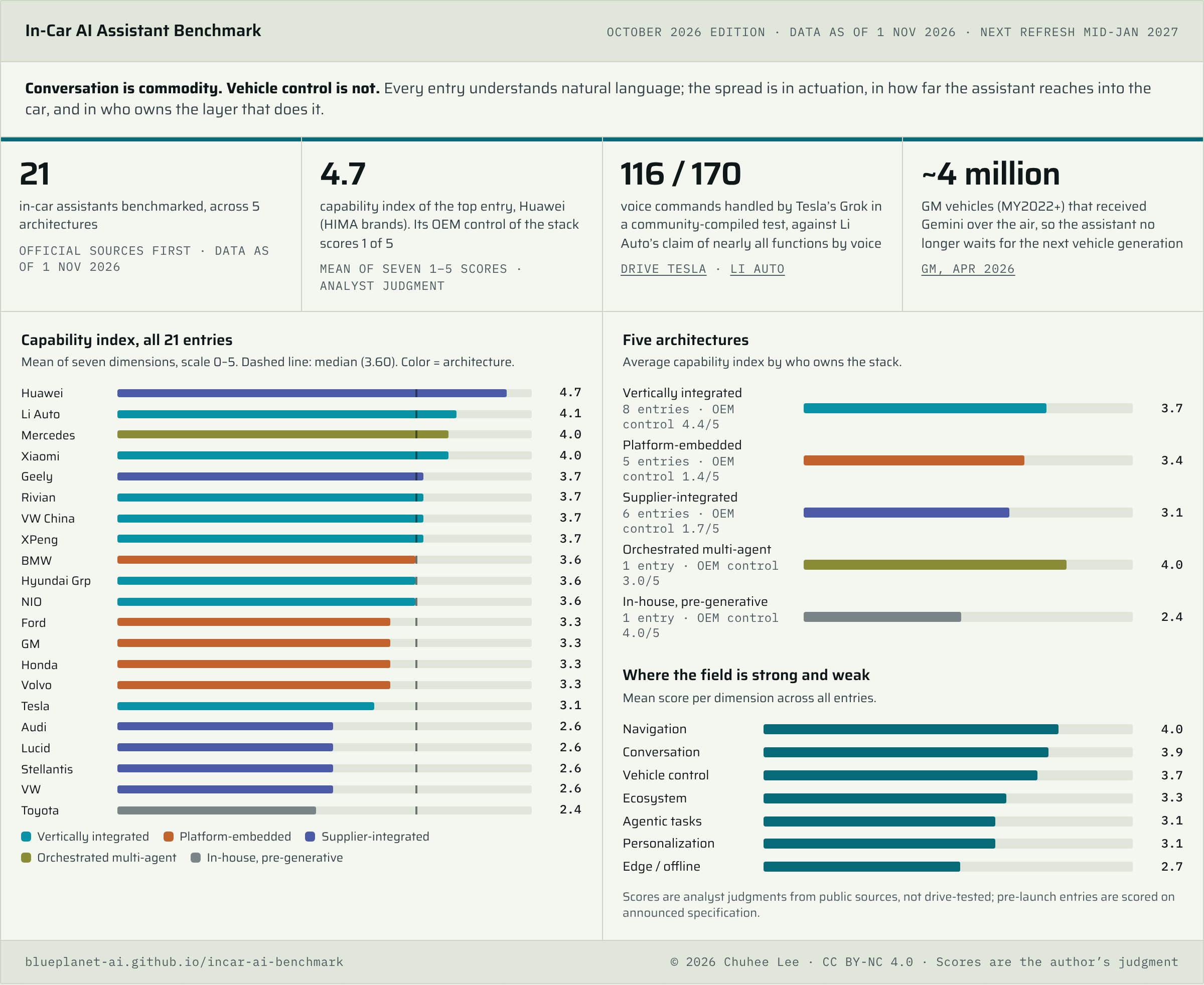
The field splits into five architectures, from fully in-house (Tesla, Rivian, Li Auto) to big-tech platforms (GM, Volvo, Honda) to supplier stacks (Huawei, Cerence and SoundHound customers). The highest-scoring cockpit, Huawei’s at 4.7, is the one its automaker partners control least. GM and Ford now pair a big-tech assistant with their own vehicle-knowledge agent, and on-device AI has started shipping, making offline competence the next differentiator.
Capability index, all 21 entries
Mean of seven dimensions · scale 0–5 · ranked
Dashed line: median across all entries. Bar color follows the architecture archetype used throughout the page.
Four routes to an in-car assistant
| Route | What it buys | What it costs | Evidence to date |
|---|---|---|---|
| Build in-houseTesla, Rivian, Hyundai, Li Auto, XPeng, NIO, Xiaomi | The deepest vehicle control, the interaction data and control of the roadmap. | A standing model-operations organization and a permanent race against consumer AI. | Rivian Assistant launched May 2026, with local AI processing on R2 and Gen 2 R1 from September; Hyundai’s Gleo AI debuted May 2026 with a target of about 20 million vehicles by 2030; Li Auto reports nearly all vehicle functions by voice. |
| OrchestrateMercedes-Benz | Own the router and the HMI; rent the brains. Best model per task, and vendors stay substitutable. | Routing quality becomes the product. Several cloud dependencies degrade together when coverage drops. | Google’s Automotive AI Agent in MBUX from the CLA; a three-model C-Class for US dealers in H1 2027 (press report); an on-device partnership with Liquid AI announced April 2026. |
| Adopt a big-tech assistantGM, Ford, Volvo, Honda, BMW | Frontier capability on the platform’s release cadence, delivered fleet-wide over the air, for little engineering. | The account, the data and the roadmap sit with the partner; differentiation narrows to voice, wake word and trim. | Gemini to about four million GM vehicles (April 2026), 16 Volvo models (30 April) and Honda (15 July); BMW iX3 with Alexa+ in 2026; GM and Ford adding their own vehicle-knowledge assistants. |
| Source from a supplierHuawei partners, Geely (export), Stellantis, Lucid, Volkswagen, Audi | A brand-owned voice, multi-market localization and a hedge across model vendors. | A capability ceiling set by the supplier’s release train and thin data rights; at the extreme (Huawei), the supplier owns agent, OS, silicon and app store. | Cerence xUI on Geely’s Galaxy M9 (April 2026) and BYD (spring 2026), plus a multi-brand Stellantis award (August 2026); SoundHound in DS, Jeep Europe and Lucid; Huawei across 13 models from five partner brands. |
Summary sources — scores are analyst judgments from public sources, not drive-tested; see method.
The strategic read
Conversation has converged across the field; the measurable spread is in how much of the car the assistant can operate.
Conversation has converged. Vehicle control has not.
Every entry on this list understands natural language, holds a multi-turn thread and answers open-domain questions — a capability bought from a handful of model vendors. The measurable spread is in how much of the car the assistant can operate. Li Auto’s official launch material says nearly all vehicle functions, down to vents and wipers, are voice-controllable; Grok reached 116 of 170 commands in a community-compiled test; Hyundai’s Gleo AI identifies which seat the speaker is in before acting. Platform integrations answer beautifully but reach the vehicle only as far as the OEM exposes its signals to them.
ImplicationDifferentiation budget belongs on the actuation layer and the signal catalog, not on conversational quality you can license.
The assistant has decoupled from the vehicle generation.
GM pushed Gemini to about four million MY2022-and-newer vehicles over the air from April 2026; Volvo followed on 30 April across 16 models dating back to 2020; Honda in July for Google built-in trims back to MY2023; Ford offers Gemini as an opt-in alternative to Google Assistant. Capability is no longer gated by the model year, the head-unit SoC or the E/E generation that shipped with the car.
ImplicationA program that waits for the next E/E architecture to launch its assistant arrives several model years after the field.
Platform assistants are becoming the bridge, not the destination.
GM and Ford now run the same dual track. GM ships Gemini today and confirmed on 31 July that its own assistant, built with an unnamed LLM provider on OnStar and vehicle data, arrives later in 2026. Ford’s AI Assistant — hosted on Google Cloud and built on off-the-shelf LLMs — is live in the app for about eight million MY2021+ vehicles and moves into the cabin in 2027, while Gemini handles general voice tasks. The interaction log, the vehicle-health relationship and the service upsell are what both are reclaiming.
ImplicationLicense the general assistant if it saves time, but keep the vehicle-knowledge agent and its data on your side of the boundary.
The edge has started shipping.
Rivian’s RivianOS 2 (4 September 2026) brought “hybrid edge compute and local AI processing” to R2 and Gen 2 R1; Rivian says R2's 200 sparse TOPS of cabin compute lets the assistant run complex tasks offline. Mercedes signed a multi-year on-device partnership with Liquid AI for third- and fourth-generation MBUX in North America. VW China says personal information in its CEA agents “never leaves the vehicle.” SoundHound announced OASYS Edge in September 2026 — fully embedded agentic voice AI that keeps working offline, deploying from late 2026 — and Cerence xUI and Amazon’s Alexa Custom Assistant on NVIDIA DRIVE AGX (automaker evaluation early 2027) are further supplier versions of the same bet.
ImplicationOffline competence and on-board privacy are becoming table stakes. The cloud-only generative path is now the laggard position.
China has moved from chat to agents — and the supplier often owns them.
At Auto China 2026 the story was agentic AI that executes tasks: Geely’s “Eva” super-agent, BMW’s three Qwen-based agents for China, VW’s full-domain agent roadmap. Alibaba says nine groups, SAIC Volkswagen among them, will put Qwen-powered in-cabin services into select models. Huawei’s HarmonySpace 6 bundles its Celia agent, cabin sensing and phone-to-home continuity for 13 models across five partner brands — and J.D. Power’s 2026 China study ranked Huawei-partnered AITO top among premium NEVs. The same study found 48% of complaints were about technology instability and inaccuracy.
ImplicationThe highest-capability cockpit on this list is also the one where the badge-holder owns the least — and rollout speed is outrunning reliability.
Owners keep rewarding restraint.
J.D. Power’s 2026 U.S. Tech Experience Index (20 August) found owners rate highest the technologies that work quietly in the background — smart ignition drew just 2.4 problems per 100 vehicles — while passenger screens drew 21.3, and 35% of owners who have one never use it. The study did not score voice assistants directly.
ImplicationScore the assistant on tasks completed without the driver looking at a screen, not on demo-able breadth.
Capability versus control
Mean capability score against how much of the model, data and interaction layer the manufacturer controls; Huawei sits far right on capability and at the bottom on control.
Horizontal: mean of the seven capability scores. Vertical: how much of the model, data and interaction layer the vehicle manufacturer controls. Huawei sits far right on capability and at the bottom on control because the control is Huawei’s, not the badge-holder’s. Entries with identical scores are nudged a few pixels apart so both stay readable; hover any point for its exact figures.
The matrix
Twenty-one assistants scored 1–5 on seven capabilities, with use cases, detail and sources behind every row.
Use-case highlights
By company · full tableWhat each assistant has been shown doing, in specific features and example requests. Text in code style is quoted verbatim from the cited source; everything else is paraphrased from it. Where a company published no concrete examples, the row says so. Grouped by architecture archetype; features common to all Google built-in cars are listed once.
| Company · assistant | Signature features (specific) | Highlight use cases | Limits and caveats | Sources |
|---|
Use-case evidence
What each assistant has been shown doingEleven use-case types, marked only where a cited source shows them. Specific features, example requests and limits for each company sit in its expandable row in the matrix above; example requests in code style are quoted verbatim from the source.
This is a coverage view, not a score: it rewards companies that publish detailed examples. Volkswagen, Audi and VW Group China have published no concrete examples, so their rows are empty. XPeng’s published example is air conditioning, which counts as climate here.
Google built-in (shared by GM, Ford, Volvo and Honda)
Google’s own examples for Gemini in cars with Google built-in. Each brand’s row adds only what it has published beyond these.
How the field is built
Five architectures, each buying something and costing something: vertically integrated, platform-embedded, supplier-integrated, orchestrated multi-agent and in-house pre-generative.
Vertically integrated
The manufacturer owns or commissions the model layer and wires it directly to vehicle signals. Rivian builds its own assistant and agent framework; Li Auto runs its proprietary MindGPT.
Platform-embedded
A big-tech assistant becomes the assistant. Gemini replaces Google Assistant inside Google built-in cars; BMW builds its Intelligent Personal Assistant on Alexa+ architecture. GM and Ford now pair this with their own vehicle-knowledge assistants.
Supplier-integrated
A tier-one delivers a branded assistant that routes to a frontier model behind it — Cerence Chat Pro and xUI, SoundHound Chat AI. Huawei is the extreme case: agent, OS, silicon and app store from one vendor.
Orchestrated multi-agent
The manufacturer keeps the router and the HMI and dispatches each request to whichever third-party brain answers it best — Google’s Automotive AI Agent for places and traffic, other models for open knowledge.
In-house, pre-generative
The OEM builds its own voice agent for commands and natural-language prompts, but has not shipped an LLM assistant in the cockpit. Toyota’s agent is built by Toyota Connected North America, with speech recognition from Google Cloud.
What moves next
A dated watch list, from VW Group China’s agents and BMW’s Alexa+-based assistant to GM’s OnStar AI Assistant reaching its first car.
VW Group China’s CEA agents confirmed in customer cars
“Agentic AI for all” begins on China Electronic Architecture vehicles — ID. AURA T6, ID. UNYX 09, the Jetta brand and Audi E7X — with CEA 2.0 unifying cockpit and driving in 2027. The first CEA model, the ID. AURA T6, launched on 20 September 2026; whether its agent shipped at launch is not yet confirmed. A test of whether a global automaker’s own agent can match local Chinese competitors.
BMW’s Alexa+-based assistant spreads beyond the iX3
Live in iX3s in Germany since spring 2026, with US deliveries under way since September. Further Operating System 9 and X models follow from H2 2026 — the test of whether a manufacturer-branded assistant on a big-tech architecture reads to customers as the manufacturer’s or as Amazon’s.
GM’s OnStar AI Assistant reaches customer cars
Announced on 21 October 2026: GM’s own assistant, woken with “Hey OnStar”, trained on the vehicle, the driver and GM’s knowledge library. It arrives first on the 2027 Cadillac LYRIQ by over-the-air update “in the coming months”, then the Chevrolet Silverado 1500 and GMC Sierra 1500, with a unified OnStar app in 2027. Reports differ on how it relates to Gemini. The first large-scale test of moving from platform-embedded to owned, on vehicles already in customers’ hands.
SoundHound OASYS Edge reaches its first deployments
Fully embedded agentic voice AI that keeps working without a connection, announced in September 2026 for deployment from late 2026 and a CES 2027 showing. No automaker customers named yet.
Ford’s AI Assistant moves into the cabin; VW’s SSP cockpit starts
Ford embeds its vehicle-knowledge assistant in select vehicles. Volkswagen’s Qualcomm-based cockpit for the Rivian-JV architecture starts with the ID.EVERY1, promising “agentic AI-driven experiences” in the Western hemisphere.
Alexa Custom Assistant on NVIDIA DRIVE AGX opens for evaluation
Edge speech, vision and language inference in the vehicle with cloud for breadth — the reference supplier-grade hybrid architecture if the latency and privacy story holds.
Huawei HarmonySpace “Active Suggestion 2.0”
Huawei’s OTA roadmap moves the cabin “from passive response to proactive service”, with Active Suggestion 2.0 scheduled for Q1 2027 (Gasgoo).
Mercedes C-Class brings the three-model router to US dealers
Watch the failure modes rather than the demo: how the router discloses which brain answered, and how it behaves out of coverage now that Liquid AI’s on-device models are in the plan.
Whether Rivian licenses its assistant beyond its own vehicles
Rivian’s CEO said in December 2025 that the UI and its embedded AI are outside the JV; its CSO said in May 2026 that discussions are under way on “similar technologies for the Volkswagen Group.” A deal would make Rivian’s stack the first in-house assistant licensed to another automaker.
Method and sources
Read before citingChange log
- 1 November 2026 watch-list check
- StatusGM announced its own assistant, the OnStar AI Assistant (21 October 2026). It reaches the 2027 Cadillac LYRIQ first by over-the-air update, then the Silverado 1500 and Sierra 1500. The GM entry, its use-case row and the watch list are updated. GM’s OEM control score stays at 1 until the assistant is in customer cars.
- CheckedThe other watch-list items were rechecked to 1 November 2026 with no material change: VW Group China’s CEA agents, BMW beyond the iX3, SoundHound OASYS Edge, Alexa Custom Assistant on NVIDIA DRIVE AGX, Huawei Active Suggestion 2.0 (still Q1 2027), the Mercedes C-Class, Ford and Volkswagen in 2027, and Rivian licensing. Other entries remain as checked to 11 October 2026. No scores changed.
- October 2026 edition
- ChangedPublished as an independent public report. Removed company-specific recommendations; the summary chart now ranks all 21 entries; the routes table covers four architectures; added author, license, disclaimer and the next scheduled refresh date.
- RefreshedData checked to 11 October 2026. BMW Launching → Shipping (assistant live in iX3s in Germany since spring 2026; US deliveries from September). Rivian Assistant now on R2 (software 2026.36). Grok extended to Israel and the UAE. VW ID. AURA T6, the first CEA model, launched 20 September. Kia Sorento (India) assistant by SoundHound. Huawei OTA roadmap and SoundHound OASYS Edge added to the watch list. Toyota re-sourced to its 2022 in-house assistant release. No scores changed.
- 27 September 2026 refresh
- AddedUse-case highlights: specific features, example requests (verbatim where published), limits and an evidence label in each company’s matrix row, plus a full use-case highlights table after the matrix, a use-case evidence grid and a shared Google built-in card.
- AddedVolkswagen Group China (CEA agentic AI) as a 21st entry, scored provisionally on VW’s announced specification.
- AddedA fifth archetype, In-house, pre-generative. Toyota moved there after official sources confirmed its Hey Toyota agent is built in-house by Toyota Connected North America and no LLM cockpit assistant has shipped; it was wrongly listed as platform-embedded.
- RescoredFord (no GenAI → shipping): Gemini opt-in plus Ford AI Assistant. Rivian edge 2→4 (RivianOS 2 local AI processing). Li Auto vehicle control 4→5 and personalization 4→5 (official Li i8 release). Lucid edge 2→3 (works without cellular for many features). Tesla OEM control 4→3 (Tesla’s page says Grok is processed by SpaceXAI and anonymous to Tesla). Toyota OEM control 3→4 (agent built in-house).
- StatusHyundai and Geely Launching → Shipping (Gleo AI live on the Korean Grandeur since May 2026; Cerence xUI on the Galaxy M9 since April 2026).
- CorrectedNIO personalization 5→4 — “long-term memory” could not be confirmed in a credible source. Stellantis “brand personalities” removed as a deployed feature — SoundHound’s release names no OEM using it. Li Auto “MindGPT 3.0” claim dropped with its aggregator source. Huawei’s “MoLA 2.0” architecture was also dropped, then restored with Huawei’s own HarmonySpace page as the source.
- UpdatedGM, Volvo, BMW, Mercedes, Rivian, Geely, Stellantis, Audi, XPeng, Huawei, Xiaomi and Hyundai status lines; findings 02–06; the watch list; and all sources, now labeled by type.
How the scores were set. Each entry was scored 1–5 per dimension from official manufacturer and supplier material first, then J.D. Power benchmark studies, then specialist trade press, current to 11 October 2026; watch-list items were rechecked on 1 November 2026. These are analyst judgments calibrated across the set, not measured results — no vehicle was instrumented or driven. Pre-launch entries (marked Launching) are scored on announced specification, which tends to overstate. Where no official English source could be retrieved, the row says so in its detail. Chinese-market rows rest mainly on trade press and remain the least certain. Readers using this benchmark to inform decisions should validate it with hands-on testing against the seven dimensions.
About this report
Author. Chuhee Lee. This is an independent, personal research project. The views and assessments are the author’s own and do not represent those of any employer or organization.
Independence. No company named here sponsored, reviewed or endorsed this report. Product names and trademarks belong to their respective owners.
Research assistance. Research, source verification and drafting were carried out with several AI models, including Claude (Anthropic), Gemini (Google) and ChatGPT (OpenAI). Every factual claim is sourced to the references listed below; scores and conclusions are the author’s judgment.
Update schedule. The benchmark is refreshed quarterly, after the major industry events. The next scheduled refresh is in mid-January 2027; every change is recorded in the change log above.
License. © 2026 Chuhee Lee. Licensed under Creative Commons Attribution-NonCommercial 4.0 International (CC BY-NC 4.0). You may share and adapt this work for non-commercial purposes with appropriate credit, a link to the license, and an indication of any changes.
Suggested citation. Chuhee Lee, In-Car AI Assistant Benchmark, October 2026 edition (data as of 1 November 2026), https://blueplanet-ai.github.io/incar-ai-benchmark/, CC BY-NC 4.0.
Corrections. Spotted an error or a newer source? Please get in touch via LinkedIn.