Chuhee Lee

At a glance
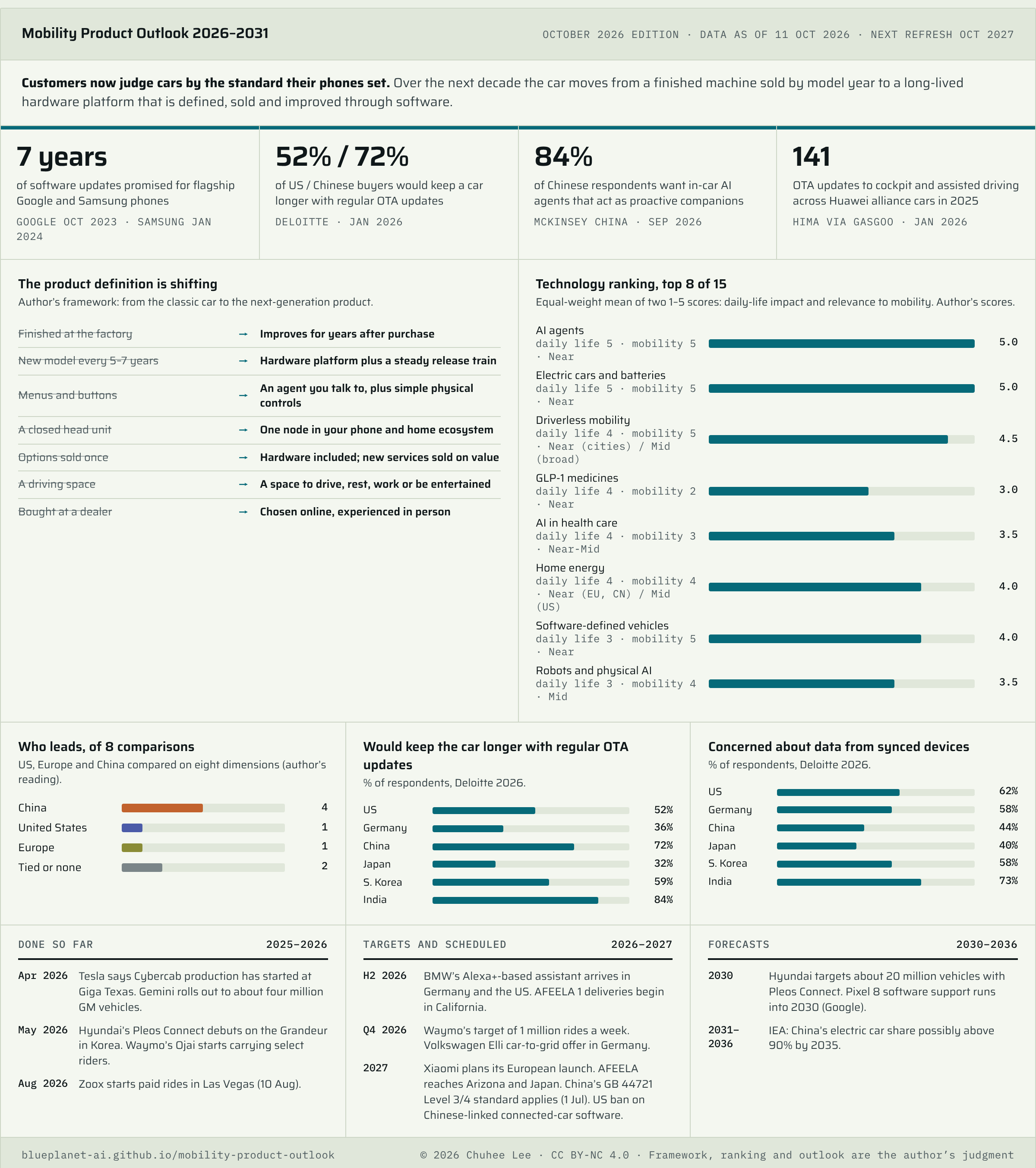
One-page summaryHeadline findingCustomers now judge cars by the standard their phones set.
Summary
The short versionCustomers now judge cars by the standard their phones set. They expect a product that improves after purchase, one assistant that follows them everywhere, a car that works with the rest of their devices, honest pricing for software, and controls that stay simple. Over the next decade this moves the definition of a car away from a finished machine sold by model year, toward a long-lived hardware platform that is defined, sold and improved through software.
Phones reset the clock: years of updates are now normal.
Google and Samsung promise seven years of software updates for their flagship phones. In the US, 52% of car buyers say regular over-the-air updates would make them keep a car longer; in China it is 72% (Deloitte 2026).
Consumer electronics companies already build cars, and fast.
Xiaomi delivered more than 600,000 cars in its first 22 months (trade press reporting Xiaomi). Huawei’s alliance brands delivered 589,107 cars in 2025 and shipped 141 over-the-air updates in that year. AlixPartners finds China’s new operating model brings cars to market twice as fast.
More technology is not the same as a better product.
J.D. Power’s 2026 study finds passenger screens among the most problematic technologies, and 35% of owners who have one have never tried it. BMW dropped paid heated-seat activation in 2023 after customers felt they had “paid double”. The winners make life simpler and charge for services that are actually new.
The product definition is shifting
Author’s framework · detail under Framework
- Classic carNext-generation product
- Finished at the factory→Improves for years after purchase
- New model every 5–7 years→Hardware platform plus a steady release train
- Menus and buttons→An agent you talk to, plus simple physical controls
- A closed head unit→One node in your phone and home ecosystem
- Options sold once→Hardware included; new services sold on value
- A driving space→A space to drive, rest, work or be entertained
- Bought at a dealer→Chosen online, experienced in person
What customers now expect
The habits people form with phones, assistants and smart homes travel with them into the car. This part sets out the shifts and what buyers in six markets say they want.
Seven lessons from consumer electronics
Evidence → implicationExpectations by market
Deloitte 2026 Global Automotive Consumer StudySix markets that set or signal the trend. China and India are most open to software-defined cars, Japan and Germany least. Concern about in-car data runs highest in the US, Germany and India. Germany stands in for Europe, as in Deloitte’s focus-market view.
Software-defined cars: useful, and a reason to keep a car longer
% of respondents · fieldwork Oct–Nov 2025
Buying direct, and worrying about data
% of respondents · fieldwork Oct–Nov 2025
All figures
| % of respondents | US | Germany | China | Japan | S. Korea | India |
|---|
Source: Deloitte, 2026 Global Automotive Consumer Study (Jan 2026; 28,000+ consumers in 27 countries). US figures confirmed in Deloitte’s US release; other figures read from the global focus-market report. Deloitte notes its online panel may favor affluent, urban consumers in China and India. Two rows in the report could not be read reliably and are left out (see Research flags).
Trendsetting markets at a glance
The wider context
Five forces behind the expectationsCustomer expectations do not form in isolation. The author’s Mega Trends Outlook 2040 sets out the long-run forces reshaping economies and societies; six of them shape directly what people want from a car. Each figure below is taken from its original source.
Energy costs are back as a household worry
% of US adults naming energy costs as their top financial problem · Gallup
Gallup Economy and Personal Finance survey, 1–15 April 2026 (1,001 adults, ±4 points). 13% is the highest since 2008; cost of living overall is cited by 31%.
Utility rate increases requested in the US
US$ billion · Consumer Reports, 23 Jul 2026
Hatched bar covers only the first half of 2026. Residential rates rose 7.3% between April 2025 and April 2026 (federal analysis cited by Consumer Reports).
Defining the next-generation product
A framework for how a mobility product is defined, built and sold in the 2030s, then concrete examples: cars already on the road that preview it, three illustrative concepts, and the robotaxi cabin.
The product-definition framework
Twelve dimensions · author’s frameworkFor each dimension: how the classic car is defined, what consumer electronics and the new entrants already do (with evidence), and the author’s view of the next-generation definition for 2030–2036.
The next-generation product as five layers that age at different speeds. Author’s framework; examples come from the evidence in this report.
| Dimension | Classic car | Consumer electronics and new entrants (evidence) | Next-generation definition, 2030–2036 (author’s view) |
|---|
Cars of the future
Real previews and illustrative conceptsPreviews you can see today
Eight vehicles and platforms that each show part of the next-generation definition. Tags link each one to the framework dimensions it illustrates.
Three illustrative cars of the early 2030s
These are not real products. Each one combines trends that are already visible into a single concept, so readers can see what the framework means in practice. The “already visible” line names the evidence each concept builds on.
A day with the family device, 2032
Illustrative scenario · author’s synthesis, not a forecast of any product
The technology foundations
The fifteen technologies that will most change daily life, ranked, with deep dives on the top eight. Each deep dive ends with what it means for product definition.
The technology ranking
15 technologies · author’s scoresEach technology is scored 1–5 on how much it changes daily life and on how much it matters to cars and mobility, with its timing and the certainty of mass adoption. Move the slider to weight the two scores, and select a row for its key evidence.
| Rank | Technology | Daily-life impact | Mobility relevance | Timing | Certainty | Weighted (1–5) |
|---|
The weighted score is arithmetic on the author’s 1–5 scores, not a sourced figure. “Mobility relevance” means how much a technology shapes vehicles, the in-car experience and the mobility industry. Humanoid robots score 3 for daily-life impact today, rising to 4 after 2032. Scores carry over from the technology research dated 3 October 2026.
Impact against certainty
Certainty of mass adoption by 2036 · author’s judgment
Why this order
Author’s judgment
- Ranks 1–6 already show mass-market adoption data and directly change routines: how people get information, travel, manage their weight and pay for energy.
- Software-defined vehicles rank only 7th for daily life, but they are what lets ranks 1, 3 and 6 work inside a car, and they underpin most of the framework above.
- Humanoid robots rank lower than the hype suggests because the IFR counted only about 7,000 sold in 2025.
- Ranks 12–15 were not researched in depth in this edition, so their scores rest on weaker evidence.
Deep dives
The top eightEach technology’s thesis, what it changes for you, the evidence, the outlook, the open questions and what it means for product definition.
US, Europe and China side by side
Technology race by region| Technology | US | Europe | China | Who leads (author’s judgment) |
|---|
Electric car share of new car sales
% of new cars · IEA Global EV Outlook 2026
The US bar is an upper bound (“just under 10%”). The IEA gives no 2026 US share; US sales in Q1 2026 were a third lower than a year earlier. Hatched bars are outlooks.
Battery pack prices, 2025
US$ per kWh · BloombergNEF, 9 Dec 2025
North America (≈$121) and Europe (≈$131) follow from BloombergNEF’s statement that their prices were 44% and 56% higher than China’s $84.
Industrial robots installed, 2025
Thousand units · IFR World Robotics 2026
Germany (24.8k) is part of the EU-27 total (60.5k, down 11%). China installed 59% of the world’s 603k.
Driverless rides per week
Thousand rides · sourced data points only
Waymo: TechCrunch, 27 Mar 2026; target stated by co-CEO Tekedra Mawakana, Feb 2026 (hatched, not achieved). Apollo Go: Baidu SEC filings. The two companies count rides on different bases.
Where the new products are
MapRobotaxi services, Level 3 permits, car-to-grid programs and the first showrooms of electronics-style carmakers named in the research. Each panel is an interactive street map (© OpenStreetMap contributors); drag or use +/− to zoom. Positions are approximate. Switch layers with the chips.
Country-wide programs (France, Germany, Switzerland) sit at an approximate country center. City lists are not exhaustive: Waymo served 15 US cities by 24 September 2026 (TechCrunch) and Apollo Go 28 cities as of August 2026 (Baidu).
What moves next
Dated milestonesObservations for the mobility industry
Observations, not adviceEight observations about product definition for the industry as a whole. They are the author’s reading of the evidence and are not recommendations to any company.
Open questions to watch
Wildcards and forecasting humility
What could change the pictureWildcards
No credible published probabilities were found, so none are given
- Big Tech takes the cabin. If phone-projection systems such as CarPlay Ultra cover every screen in most new cars, the carmaker’s own interface becomes a thin layer.
- The opposite: carmakers close the door. GM plans to remove CarPlay and Android Auto across its line-up; if buyers accept that, native systems win.
- AI progress stalls, or jumps. METR’s task benchmark is close to its measurable limit, so 2027–2030 is uncertain in both directions.
- An electricity-price backlash. If power bills keep rising, home charging and car-to-grid could become either a selling point or a political target.
- A privacy shock. A major in-car data breach or camera misuse case could slow AI cabins and data-based services.
- A faster US–China tech split that forces separate products for each bloc, and a major robotaxi accident that resets permits.
Caveats
Read before relying on the outlook
- Five-to-ten-year technology forecasts have often been wrong in both directions. Robotaxi timelines were over-promised in 2015–2020, while electric car and generative AI adoption beat many forecasts.
- Survey answers are not purchases. Stated interest in software and services has often exceeded what buyers later pay for.
- Several case-study figures come from trade press reporting company statements rather than from the companies’ own filings; they are labeled in the sources.
Method and sources
Read before citingChange log
- 4 November 2026
- Changed“Where the new products are” now uses interactive street maps (OpenStreetMap) instead of flat latitude–longitude plots. The sites and layers are unchanged.
- ChangedAn “In this report” contents list follows the 60-second summary, and the section bar now uses the same design as the site’s other reports. The region lens, which dimmed two of the three regions in the comparison tables, was removed; the tables are unchanged.
- 18 October 2026
- AddedA note under the title says that some outlook statements look past 2031 and will be revisited at the October 2027 refresh. The report text is unchanged.
- 17 October 2026
- ChangedTitle and horizon label changed from 2026–2036 to 2026–2031 to match the site’s Shifts layer (one to five years). The report text is unchanged; passages that look beyond 2031, including the framework’s 2030–2036 view, will be reviewed at the next refresh.
- October 2026 edition
- NewFirst public edition. Consumer electronics, customer expectation and case-study data checked to 11 October 2026; technology ranking data checked to 3 October 2026. The wider-context section builds on the author’s Mega Trends Outlook 2040 (October 2026 edition).
Research flags
Conflicts between sources, unverified items and gaps. None has been resolved silently.
Terms used
About this report
Author. Chuhee Lee. This is an independent, personal research project. The views and assessments are the author’s own and do not represent those of any employer or organization.
Independence. No company named here sponsored, reviewed or endorsed this report. Product names and trademarks belong to their respective owners.
Research assistance. Research, source verification and drafting were carried out with several AI models: mainly Claude (Anthropic), with Gemini (Google) and ChatGPT (OpenAI) used for smaller supporting references. Every factual claim is sourced to the references listed below; the framework, scores and conclusions are the author’s judgment.
Update schedule. The outlook is refreshed once a year. The next scheduled refresh is in October 2027; every change is recorded in the change log above.
License. © 2026 Chuhee Lee. Licensed under Creative Commons Attribution-NonCommercial 4.0 International (CC BY-NC 4.0). You may share and adapt this work for non-commercial purposes with appropriate credit, a link to the license, and an indication of any changes.
Suggested citation. Chuhee Lee, Mobility Product Outlook 2026–2031, October 2026 edition (data as of 11 October 2026), https://blueplanet-ai.github.io/mobility-product-outlook/, CC BY-NC 4.0.
Related report. The Mega Trends Outlook 2040 covers the long-run economic, social and geopolitical forces behind the expectations in this report.
Corrections. Spotted an error or a newer source? Please get in touch via LinkedIn.