Chuhee Lee

At a glance
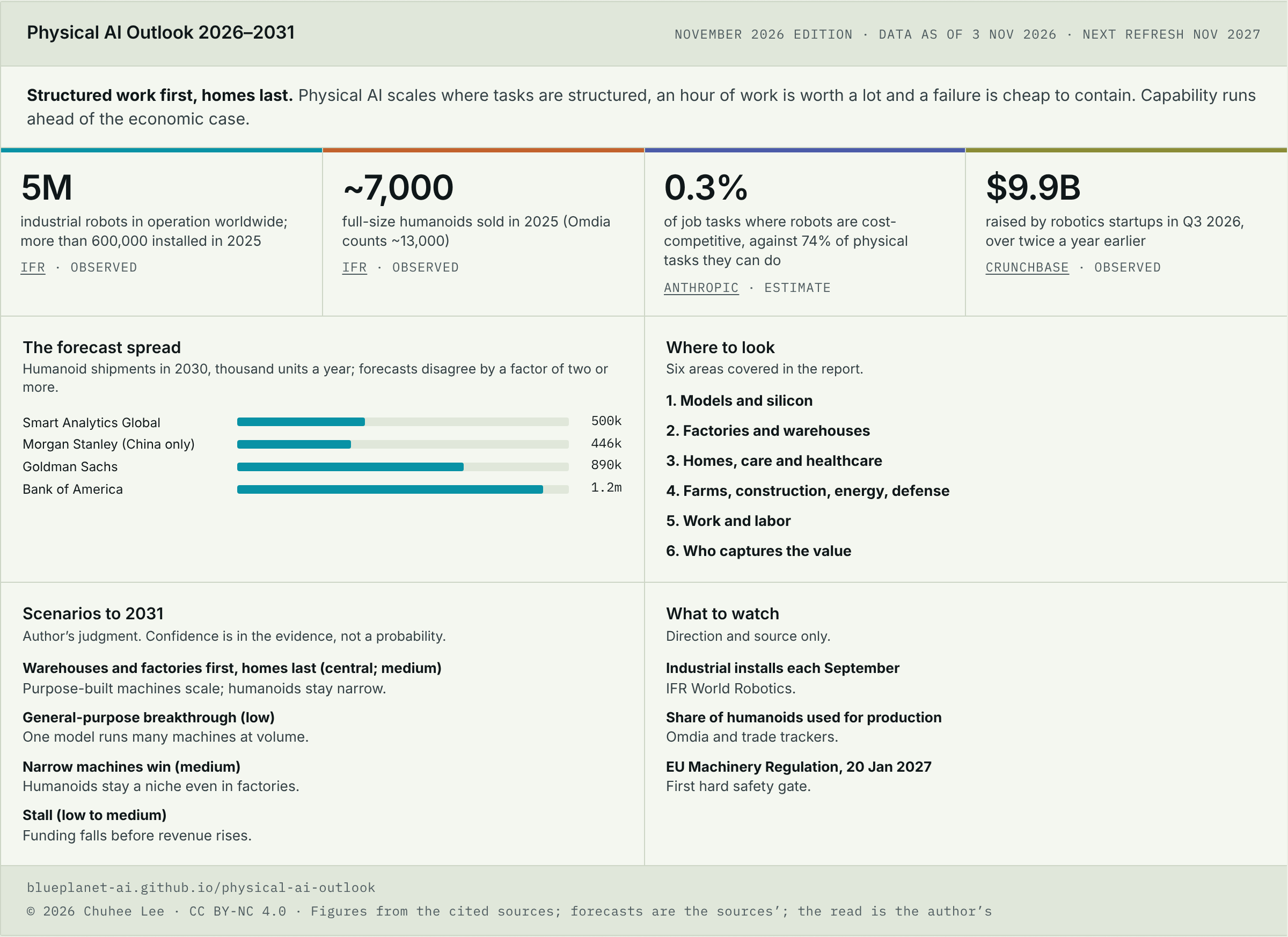
One-page summaryHeadline findingPhysical AI will scale first where tasks are structured, the value of an hour of work is high and a failure is cheap to contain: warehouses and factories. Homes come last. Capability is wider than the economic case, so most of the next five years is about cost, safety and proof, not about what a robot can do in a demo.
Summary
The short versionPhysical AI, meaning AI that senses and acts in the real world, is already large in one form and small in another. Conventional industrial and warehouse robots are a measured, growing business. The general-purpose humanoids that dominate attention number in the thousands, and forecasts for them disagree by wide margins. The author’s central case for 2031 is that machines scale first where work is structured, the value of an hour is high and a failure is cheap to contain: warehouses and factories. Farms, construction, energy and defense follow in narrower forms. Homes and care come last. Most of the gains land with a few companies in chips, models and operations, and the cost, safety and proof needed before wide use set the pace more than capability does.
The measured base is conventional robots.
The IFR counts 5 million industrial robots in operation, more than 600,000 installed in 2025 and about 250,000 professional service robots sold, of which 117,500 were logistics machines. China installed 354,000, or 59% of the world’s industrial robots. The IFR forecasts 806,000 installations in 2029.[1][2]
Humanoids are early, and forecasts split.
Counts for 2025 run from about 7,000 to 20,000 depending on definition and source. For 2026, forecasts run from 50,000 (China only) to nearly 100,000 worldwide. Gartner expects fewer than 20 companies to reach production by 2028, and Interact Analysis puts the inflection in 2032.[2][3][4][6][9]
Work changes in tasks before it changes in headcount.
Robots can technically do about a third of US working hours, but are cost-competitive for 0.3% of job tasks in Anthropic’s analysis. Studies of past robot adoption find job losses in manufacturing offset elsewhere in Germany, and local harm in US manufacturing towns.[5][10][11]
Capital arrives faster than revenue.
Robotics startups raised $9.9 billion in the third quarter of 2026 and Unitree’s shares rose 460% at the first-day close, then fell about 45% from the intraday peak within a week. Public data cannot yet show whether chips, models, makers or operators earn the margin.[7][12]
Rules arrive on dates.
The EU Machinery Regulation applies in most provisions from 20 January 2027 and treats AI safety components that change their own behavior as high-risk. A revised ISO standard for industrial robot safety was cited in the EU Official Journal in September 2026. As of September 2025, UN talks on autonomous weapons had not reached negotiations; the 2026 outcome is unconfirmed.[13][14][15]
The forecast spread: humanoid shipments in 2030
Thousand units a year · bank and analyst forecasts
Different geographies and publication dates; Morgan Stanley covers China only, and Interact Analysis forecasts 2035, not 2030. Goldman raised its 2030 figure from 256,000 this year.[4][16][9][17] The author reads the width of the range as the main fact.
Where we start in 2026
Physical AI is measured today by conventional robots; the machines in the headlines are a rounding error next to them, and every count is a proxy for what this report is about.
Definition. Physical AI here means AI that senses the world and acts on it under safety constraints. No official statistic counts that. The International Federation of Robotics (IFR) counts robots by type, whether or not a learned model controls them, so every figure below is a proxy for adoption, not a count of physical AI itself.
Factories. The IFR counts 5 million industrial robots in operation, up 9%, and more than 600,000 installed in 2025, up 11%. China installed 354,000 (59% of the world), the United States almost 38,500 (up 12%), Japan 36,219 (down 19%), South Korea 30,000 and Germany under 25,000 (down 8%). Chinese suppliers made 195,000 of China’s robots, a 55% domestic share.[1] The IFR forecasts 655,000 installations in 2026 and 806,000 in 2029, and its release does not mention humanoids.[1]
Services and homes. Professional service robots sold almost 250,000 units in 2025, up 24%, with logistics robots the largest group at 117,500 (47%). Consumer robots, mostly floor cleaners and lawn mowers, sold almost 34.2 million units, up 37%.[2] Amazon said in June 2025 that it had deployed its millionth robot.[18]
Humanoids. The IFR counts about 7,000 full-size humanoids (above 140 cm) sold for commercial use in 2025.[2] Omdia estimated about 13,000 shipped in 2025 (published January 2026), led by AgiBot (5,168), Unitree (4,200) and UBTech (1,000).[3] Bank of America puts 2025 shipments at 20,000, again on its own definition.[17] The two figures use different definitions and should not be averaged or added to the industrial count. Unitree’s prospectus gives 2025 revenue of 1.699 billion yuan and “over 5,500” humanoids sold.[19]
Driving as a proof point. Driving is the one place where learned systems already act on public roads at consumer scale, and it is covered in the site’s mobility reports rather than here. Tesla reports 1.74 million active FSD subscriptions in the third quarter of 2026, a company figure relayed by a secondary source.[20] It shows what a structured, high-value, rule-bound task looks like when it scales.
Industrial robots installed in 2025, by country
Thousand units · IFR World Robotics 2026
Germany is drawn at 25,000; the IFR reports “fewer than 25,000”.[1]
Humanoids in 2025: two definitions, one order of magnitude
Units · IFR (sold, full-size) and Omdia (shipped)
Company bars are Omdia’s split of its own total. Counts of shipments include units bought for research, demonstration and entertainment.[2][3]
The models and chips under the robot
Robot foundation models and edge computers are improving fast, but the independent evidence says the gap between a controlled demo and the real world is still wide.
What is claimed. NVIDIA calls its Jetson Thor edge computer “the ultimate supercomputer to drive the age of physical AI and general robotics”, a product claim with no independent deployment data behind it.[21] Model developers argue that large vision-language-action models trained across many robot types will let one model control many machines.
What independent work finds. The Stanford AI Index 2026 finds that robots still fail at most household tasks even as they excel in controlled environments.[22] Robot training data must come from physical robots or simulation, which is why it is scarcer than the text and images behind chatbots.
What is not known. No source opened for this report gives audited uptime, intervention rates or maintenance cost for learned-model robots in commercial service.
Factories and warehouses
The purpose-built machines scale; the humanoids so far mostly demonstrate. The next five years decide whether any of them earn a place on the floor.
The measured part. Warehouse automation is already commercial. Amazon said in 2025 it had deployed its millionth robot; Symbotic reported $721 million of quarterly revenue and 77 systems in deployment.[18][23] Logistics is the largest group of professional service robots at 117,500 units a year.[2] Product selection still fails: Amazon stopped its Blue Jay warehouse robot after under six months while keeping its other robots.[24]
Humanoids on the floor. Boston Dynamics said in January that production Atlas robots begin manufacturing immediately and that all 2026 units are committed to Hyundai’s robotics application center and Google DeepMind, with more customers in early 2027. Hyundai announced a $26 billion US investment that includes a robot factory for 30,000 robots a year.[25] Tesla says Optimus production has started on its Fremont lines and gave no unit count; Elon Musk has said Tesla could make 20,000 a week by the end of 2027, a target, not output.[26] All of these are company statements.
Who buys. In Gasgoo’s trade data on Chinese humanoids, 35% of shipments went to entertainment and performance, 20% to data collection and research, and under 15% of orders were used in production work that creates direct industrial value; Gasgoo also saw no large repeat orders or proven return-on-investment model. Prices range from under 10,000 yuan to more than 400,000 yuan.[8] Gartner expects “fewer than 20 companies” to go live in production with humanoids in supply chain and manufacturing through 2028, and says they cost multiple times more than task-specific robots with lower throughput.[6]
Forecasts. Forecasts of humanoid units are unsettled. For 2026 they run from 50,000 in China (Morgan Stanley) to nearly 100,000 worldwide (Gasgoo), a 1.7-times spread among the global estimates. For 2030 they run from 500,000 (Smart Analytics Global) to 890,000 (Goldman Sachs), and Bank of America reaches 1.2 million.[16][8][4][17] Goldman raised its 2030 figure from 256,000 this year. Interact Analysis forecasts over 700,000 units and $15 billion of revenue only in 2035, with real-world applications about a tenth of 2025 production.[4][9]
Humanoid shipments in 2026: the forecasts
Thousand units · bank and analyst forecasts
Morgan Stanley’s figure covers China only and is not comparable with the global ones.[16][8][4][17]
What buyers use humanoids for
Share of shipments and orders · Gasgoo, August 2026
The outlet’s own trade data; method not shown. The bars do not sum to 100%.[8]
Homes, care and healthcare
The home is the hardest setting for a machine and the last to be won. Healthcare already uses robots, but the surgeon stays in the loop.
Homes. Consumer robot sales of almost 34.2 million units in 2025 are floor cleaners, lawn mowers and similar narrow machines.[2] They show demand for a single useful job at a low price, not for a general household helper. The opened sources contain no probability-sample survey of willingness to pay for a home humanoid, and no audited home deployment, so those are gaps. Interact Analysis lists safety and environmental complexity as the barrier for household use.[9]
Surgery. Intuitive Surgical’s da Vinci systems supported about 3.15 million procedures in 2025 (preliminary, unaudited), and the company expects 13% to 15% growth in 2026.[27] The IFR counted 8,400 surgical robots sold.[2] The FDA states that these devices cannot operate without direct human control.[28] Growth in surgical robots is therefore growth in surgeon tools, not in autonomous care.
Care. The research found no commercial deployment data on elder-care humanoids and no sourced survey of hospital or home-care buyers; claims that hospitals will or will not adopt them are unverified.
Farms, construction, energy and defense
Outdoor and high-stakes settings are big labor pools but hard for machines; drones and defense move first because buyers there pay for capability, not payback.
Thin evidence. This is the least documented chapter. The research found no current, comparable deployment dataset for agriculture, construction, mining or utilities. The numbers that exist are about money and rules, not machines in the field.
Money. Crunchbase’s article on robotics funding to mid-June 2026 names a $1.75 billion Series D for Saronic, a defense maritime company, valued at $9.25 billion; it does not say whether the $18.8 billion total includes defense.[29] One secondary account says the third-quarter total of $9.9 billion excludes defense companies, while another does not say.[7][30] The counts may therefore not be comparable. Drone unit volumes are not sourced anywhere in this report.
Rules. The International Committee of the Red Cross separates weapons that merely fly themselves from those that select and apply force to targets, and says legal compliance may require certain autonomous weapons to be ruled out.[31] At the UN’s expert group on autonomous weapons in September 2025, 42 states said they were ready to move toward negotiations on the chair’s draft text. Negotiations had not begun. Whether the 2026 session moved further is not confirmed in the sources opened.[15]
Work and labor
Robots are already able to do a third of US working hours on paper. The economics, and the history of earlier robots, point to slower and more local change than the headlines imply.
The new estimate. Anthropic’s Economics team rated about 7,600 physical tasks from the US occupational database. It finds robots can already perform 74% of physical tasks, about 34% of working hours, mostly in limited settings. It estimates that robots are cost-competitive against human labor for just 0.3% of job tasks. In its worked example the cost model assumes a ten-year service life and an 8% cost of capital, and it assumes robot prices falling about 3% a year, a pace at which 10% cost-competitiveness would take about 40 years. The authors call the result suggestive and note that AI could let robots learn tasks they cannot do today.[5] Anthropic wrote the study and Claude scored the tasks. This report is also produced with Claude, so the figure is one input among several, not the anchor.
What earlier robots did. A German study of 1994–2014 found each industrial robot destroyed about two manufacturing jobs, with the loss fully offset by additional jobs in services. Incumbent workers in exposed plants mostly stayed with their employer, at lower wages; the manufacturing decline came from fewer hires of young entrants.[10] In the United States, one more robot per thousand workers lowered the local employment rate by about 0.2 percentage points and wages by about 0.42% across commuting zones between 1990 and 2007.[11] A later German study found that works councils reduce separations among incumbent workers and do not hinder robot adoption.[32]
What forecasters add. McKinsey’s US scenario to 2035 sees automation reducing labor demand by the equivalent of about 36 million jobs while other demand creates over 40 million, but it covers all AI and is not about robots alone.[33] The IFR points to labor shortages, demographic change and the relocation of manufacturing as drivers of factory automation.[1] No source found models jobs created or lost by physical AI to 2031, and this report offers no net-jobs number.
Able, not yet worth it
Share of US physical tasks, working hours and job tasks · Anthropic Economics, September 2026
The first two bars measure technical capability, the third cost-competitiveness; the bars have different bases.[5]
Who captures the value
Money is flowing in at record speed, but public data cannot yet show which layer earns the margin: chips, models, makers or operators.
Capital. Robotics startups raised $18.8 billion in 2026 through mid-June, more than the $15 billion of all of 2025 and the $14.1 billion of 2021, and $9.9 billion in the third quarter alone, more than twice the $4.3 billion of a year earlier. Year to date, Chinese robotics startups raised $13.2 billion and US ones $12.1 billion.[29][7] Funding is capital raised, not sales.
Public markets. Unitree listed on Shanghai’s STAR Market on 19 August 2026, rose 460% at the first-day close, with a value touching about $66 billion intraday, then fell about 45% from that peak by 25 August.[12] Reuters reported on 28 October that the shares had fallen further, almost 55% from their debut, before a partial rebound.[34] For the first nine months of 2026 its revenue rose 55.7% to 1.817 billion yuan, but profit excluding one-off items fell 18.8% as research spending rose 191%. Reuters reported third-quarter profit down 17.4%.[35][34] Goldman Sachs projects a $138 billion humanoid market in 2035.[4]
The open question. The working hypothesis is that value concentrates in chips, models and a few operators. The opened sources do not support or reject it: no public series compares gross margins along the stack, and the reviewers who tested it disagree. Chip and model vendors cite scarce inputs; system integrators and service firms argue that safety certification, spare parts and uptime guarantees are where customers stay locked in.
Three setups. China has manufacturing scale: Chinese suppliers hold 55% of their home market and the country installed 59% of the world’s industrial robots.[1] The United States has cloud, model and operating capital, with Amazon, Tesla and the major chip designers. Europe has automation incumbents and the first hard rules. Appendix A lists named players.
Robotics startup funding
Billion dollars · Crunchbase
Different periods and category definitions. Whether defense is included is not stated for the June count, and one account says the Q3 count excludes it.[29][7]
What holds it back
Seven forces slow the shifts: a real-world gap in models, cost, proof, safety rules, weapons law, capital cycles and measurement.
| Force | Evidence | Effect on the shifts | Kind |
|---|---|---|---|
| Real-world gap | Stanford’s AI Index: robots still fail at most household tasks even as they excel in controlled environments.[22] | Keeps learned models inside structured cells. | Survey |
| Cost | Cost-competitive for 0.3% of job tasks; Gartner: humanoids cost multiple times more than task-specific robots.[5][6] | Slows adoption to tasks with high labor cost per hour. | Forecast |
| Proof | Under 15% of humanoid orders used in production work; real-world applications about a tenth of 2025 production.[8][9] | Buyers wait for repeat orders and audited return on investment. | Observed |
| Safety rules | EU Machinery Regulation applies from 20 January 2027 (most provisions), with AI safety components that change their own behavior on the high-risk list; ISO 10218:2025 replaces the blanket safety-performance requirement with function-specific levels, and European references were published in September 2026.[13][14] | Certification becomes a gate in Europe, and sets design norms elsewhere. | Observed |
| Weapons law | UN experts had a draft text and 42 states ready to negotiate in September 2025; ICRC says autonomous targeting raises legal concerns.[15][31] | Slows autonomous lethal systems; leaves drones for sensing and logistics freer. | Observed |
| Capital cycles | Unitree fell about 45% from its intraday peak within a week of listing, and Reuters later reported a further fall and a partial rebound.[12][34] | A funding reversal would hit startups before revenue catches up. | Observed |
| Measurement | Humanoid counts differ by definition (7,000 or 13,000), and it is unclear whether funding counts include defense.[2][3][29] | Makes progress hard to verify; favors claims. | Observed |
Scenarios to 2031
The author’s central case is that structured work scales first and homes come last. Two alternatives move the pace; a stall would slow all of it.
How good are such forecasts? Humanoid forecasts have moved fast. Goldman Sachs raised its 2030 figure from 256,000 to 890,000 units and its 2035 figure from 1.38 million to 6.5 million this year; Morgan Stanley raised its China figure for 2026 from 14,000 in January to 28,000 and then to 50,000 by June.[4][16] Forecasts that move this much, with no order book behind them, deserve little weight, which is why this report shows ranges. The IFR’s industrial forecasts rest on a long record of census data and deserve more.
| Scenario | What 2031 looks like | Evidence for | Evidence against | Confidence |
|---|---|---|---|---|
| Warehouses and factories first, homes last central case | Purpose-built and learned-perception robots keep growing in logistics and factories; humanoids work in a few thousand big-company sites; homes hold single-purpose machines. | 5 million robots in operation, 806,000 installs forecast for 2029, 117,500 logistics robots, Symbotic and Amazon fleets. | Amazon stopped Blue Jay; under 15% of humanoid orders for production. | Medium |
| General-purpose breakthrough | One robot model works across many machines and sites; humanoids reach factories, hospitals and some homes at volume. | Goldman and Bank of America curves; falling Chinese prices; Atlas and DeepMind integration. | Stanford’s finding on household tasks; Gartner’s fewer-than-20; Interact Analysis puts the inflection in 2032. | Low |
| Narrow machines win | Wheeled and fixed robots with better AI take almost all the work; humanoids stay a niche even in factories. | Gartner’s cost and throughput finding; logistics growth; surgical robots. | Brownfield sites built for people; model transfer improving. | Medium |
| Stall | Funding falls before revenue rises; incidents and rules slow deployment; the story resets. | Unitree’s drop; order mix; profit pressure at the listed makers. | Record installs; labor shortages. | Low to medium |
Confidence describes how well the evidence supports each story, not a probability. The central case and “Narrow machines win” overlap: they differ on whether humanoids reach production at all.
What would change the picture
EU Machinery Regulation
Guidance and the first conformity assessments for AI safety components. Smooth certification supports the central case; delays support a stall in Europe.[13]
Appendices
Players and rulesAppendix A. Who is building what
| Player | Setup | What the sources show | Kind |
|---|---|---|---|
| Unitree | China | 2025 revenue 1.699 billion yuan; over 5,500 humanoids sold; listed 19 August 2026; Q3 revenue 665 million yuan, up 69.9%.[19][35] | Company |
| AgiBot, UBTech | China | Omdia counts 5,168 AgiBot and 1,000 UBTech humanoids shipped in 2025.[3] | Observed |
| Tesla (Optimus) | US | Production started on Fremont lines; no unit count.[26] | Company |
| Boston Dynamics, Hyundai | US, Korea | 2026 Atlas units committed to Hyundai and Google DeepMind; $26 billion US investment including a 30,000-robot-a-year factory.[25] | Company |
| Amazon | US | One million robots deployed by June 2025; Blue Jay stopped in 2026.[18][24] | Company |
| Symbotic | US | $721 million quarterly revenue and 77 systems in deployment (fiscal Q3 2026).[23] | Company |
| Intuitive Surgical | US | About 3.15 million da Vinci procedures in 2025; expects 13% to 15% growth in 2026.[27] | Company |
| NVIDIA | US | Jetson Thor edge computer marketed for physical AI; no independent deployment data.[21] | Company |
| Saronic | US | $1.75 billion Series D at $9.25 billion valuation (March 2026), a defense maritime company.[29] | Observed |
Not found in the opened sources: current status of Figure, Apptronik, Agility and 1X; the close of any Physical Intelligence round. They are left out rather than guessed.
Appendix B. Rules and standards
| Rule | Region | What it does | Status |
|---|---|---|---|
| Machinery Regulation (EU) 2023/1230 | EU | Updates the Machinery Directive 2006/42/EC; puts AI safety components with self-evolving behavior on the high-risk list.[13] | Most provisions apply 20 January 2027 |
| ISO 10218-1 and -2:2025 | Global, EU references | Folds ISO/TS 15066 into the robot-system part; function-specific performance levels; a separate normal-stop function. The explainer cited does not discuss humanoids or mobile manipulators.[14] | Published Feb 2025; EU references Sep 2026 |
| FDA oversight of robotic surgery | US | Clears devices that operate under direct human control.[28] | In force |
| UN expert group on autonomous weapons | Global | Chair’s draft text; 42 states ready to negotiate (Sep 2025).[15] | No treaty; 2026 outcome unconfirmed |
| US and China equivalents | US, China | No single binding regime comparable to the EU’s was found in the research; product-by-product rules apply. | Gap |
Method, limits and flags
Read before citingQuestion. How will physical AI, meaning AI that senses and acts in the real world, change work, the economy and everyday life by 2031, and where will it scale first?
Scope. Global, with the United States, China and Europe as three setups. Three sectors (factories and warehouses; homes, care and healthcare; farms, construction, energy and defense including drones) and three impacts (work and labor, economy and value, daily life). Driving appears only as a proof point; the site’s mobility reports cover cars and cabins.
Sources. Research papers and institutes first, then industry bodies, analysts and banks, then company disclosures and major news and trade publications. Each reference carries its type and date. Observed, survey, forecast and company figures are kept apart and labeled.
How the research was done. Claude, Gemini (papers, standards, government) and ChatGPT (analysts, filings, news) each answered the same written brief. Claude compared the three, opened the sources behind the figures used, and merged them; Gemini’s unsupported figures were dropped. Framing, the nine chapters, the scenarios and conclusions are the author’s.
What this report is not. The “author’s forecast” boxes and the four scenarios are judgments based on the evidence cited. Confidence labels describe how well the evidence supports a statement, not a probability. Signposts give a direction and a source, not a numeric threshold.
Flags and open questions
- Forecasts, not measurements. Banks (Goldman, Morgan Stanley, Bank of America) cover robot and chip stocks, Gartner and Interact Analysis sell analysis, and the IFR represents robot makers. Company figures (Unitree, Tesla, Boston Dynamics, Amazon, NVIDIA) are claims. Each is labeled.
- Research round with Gemini and ChatGPT. Both models answered the same written brief. Claude compared the three answers and opened the sources behind the figures used here. ChatGPT’s answer was largely confirmed; Gemini’s was mixed, with some precise figures that no source supported, which are left out.
- Corrections from that round. Gemini’s industrial-robot figures (603,307 installs; China 54%) repeated numbers from the earlier edition; the IFR page says “more than 600,000” and China 59%, so those are used. The IFR counts about 7,000 full-size humanoids and Omdia about 13,000 because the definitions differ. Gartner’s prediction is “fewer than 20 companies going live in production”, with no unit volume attached. Unitree listed on 19 August, not in July as the October edition said.
- The Anthropic study. The robot task and cost study was written by Anthropic’s Economics team and Claude scored the tasks. This report is also produced with Claude. The study is used as one input, with its own caveats, and no conclusion rests on it alone.
- Definitions differ. Industrial robots (IFR), service robots (IFR) and humanoids (IFR, Omdia) are different counts and are never added. Crunchbase’s “robotics” counts differ on defense; the 185% growth rate it publicly states is not used because the article ties it to different periods.
- Unitree profit. TechNode reports nine-month profit excluding one-off items down 18.8% and reported profit up 270.5% because of a one-off share-based payment a year earlier; Reuters reports third-quarter profit down 17.4%. The report quotes both and does not merge them.
- Independent fact-check. A reviewer who did not write the report checked its sourced claims against the cited pages on 3 November. Findings were applied: one claim about German workers was corrected, several quotations were removed or reworded, and stale or overreaching wording on Unitree, Interact Analysis, Tesla, the UN talks and defense funding was fixed. Bank of America, Symbotic, Intuitive, the IFR surgical count, the FDA statement, the IAB, ZEW and Acemoglu and Restrepo papers, the ICRC statement and Reuters’ Unitree profit figure were confirmed. McKinsey’s scenario was confirmed only through secondary reports. The Stanford AI Index is paraphrased from its confirmed highlight; the quotation first used could not be found.
- Secondary reports. Where the primary page could not be opened, a named secondary report is cited: Goldman and Morgan Stanley forecasts via Humanoid Guide and AI Weekly; Morgan Stanley’s 2030 China figure of 446,000 is attributed by AI Weekly’s headline and was not matched to the original CNBC report; Tesla’s update via TechCrunch and TeslaNorth; Unitree’s prospectus via Gasgoo and its listing via The Next Web; Gartner’s prediction was read on Gartner’s own page.
- Not found. No source found for: audited uptime and maintenance cost of humanoids in commercial service; survey data on willingness to pay for home or care robots; current deployment data for farms, construction, mining or utilities; drone unit volumes; a US or Chinese rule comparable to the EU Machinery Regulation; a 2026 outcome of the UN talks on autonomous weapons; margins along the robotics value chain; a forecast of net jobs from physical AI to 2031.
- Left out. A headquarters map and a full player table are not included; Appendix A lists only players with a sourced figure. Cabin and passenger-car material is covered by the site’s mobility reports.
Change log
- November 2026 edition
- ChangedReplaces the October 2026 edition, “Physical AI and the Rider’s Cabin”, with a five-year forecast of physical AI across sectors. The cabin material moves to the site’s mobility reports. The address changed from /physical-ai-cabin/ to /physical-ai-outlook/. Corrections to the earlier figures are listed in the flags above.
About this report
Personal research by Chuhee Lee. Research, source verification and drafting were carried out with several AI models, including Claude (Anthropic), Gemini (Google) and ChatGPT (OpenAI). Every factual claim is sourced to the references listed below; topic selection, framing and conclusions are the author’s. These are personal views, not those of any employer.
References
- [1] Five Million Robots now Operate in Factories Globally (World Robotics 2026), IFRIndustry body · 24 Sep 2026
- [2] Global Sales of Professional Service Robots Surge 24%, IFRIndustry body · 30 Sep 2026
- [3] China’s AgiBot leads global humanoid robot shipments in 2025, Omdia says, TechNodeTrade news on analyst data · 9 Jan 2026
- [4] Goldman raises 2035 humanoid robot forecast to 6.5 million, Humanoid Guide (reporting Goldman Sachs)Bank forecast, secondary · 15 Sep 2026
- [5] What work can robots do?, Anthropic Economics teamCompany research · 30 Sep 2026
- [6] Gartner Predicts Fewer Than 20 Companies Will Scale Humanoid Robots for Manufacturing and Supply Chain to Production Stage by 2028Analyst forecast · 21 Jan 2026
- [7] Robotics startups raised $9.9B in Q3, more than twice last year’s haul, RuntimeWire (reporting Crunchbase)News on data provider · 27 Oct 2026
- [8] The “Schism” in Humanoid Robotics: Hype Goes Viral, But Practical Application Has “Short Legs”, GasgooTrade research · 15 Aug 2026
- [9] Humanoid robot revenue to reach $15bn by 2035, Interact AnalysisAnalyst forecast · 21 May 2026
- [10] German robots: the impact of industrial robots on workers, Dauth, Findeisen, Südekum and Wößner, IABWorking paper · 2017
- [11] Robots and Jobs: Evidence from US Labor Markets, Acemoglu and Restrepo, Journal of Political EconomyPeer-reviewed paper · 2020
- [12] Unitree shares slump 45% from peak on bubble fears, The Next Web (citing Reuters)News · 25 Aug 2026
- [13] Machinery Regulation, Product Risk Radar, Baker McKenzieLaw firm summary · Nov 2025
- [14] New standards for industrial robots: EN ISO 10218-1 and -2, IBF SolutionsStandards explainer · Sep 2026
- [15] Group of governmental experts on autonomous weapons digs into details of elements for a treaty, Reaching Critical WillCivil-society report · 11 Sep 2025
- [16] Morgan Stanley doubles China humanoid robot forecast to 50,000, AI Weekly (citing CNBC)Bank forecast, secondary · 25 Jun 2026
- [17] Physical AI, part 2, Bank of America InstituteBank forecast · 2026
- [18] Amazon launches a new AI foundation model to power its robotic fleet and deploys its 1 millionth robotCompany · 30 Jun 2025
- [19] Unitree launches STAR Market IPO issuance process, GasgooTrade news on prospectus · 31 Jul 2026
- [20] Tesla Q3 2026 earnings, TeslaNorth (quoting Tesla’s update)News, secondary · 21 Oct 2026
- [21] NVIDIA Blackwell-Powered Jetson Thor Now AvailableCompany · Aug 2025
- [22] AI Index Report 2026, Stanford HAIResearch institute · 2026
- [23] Symbotic Reports Third Quarter Fiscal Year 2026 ResultsCompany filing · 5 Aug 2026
- [24] Amazon cans a major warehouse robotics project, but Blue Jay will live on, TechRadar (citing TechCrunch)News · 22 Feb 2026
- [25] Boston Dynamics unveils new Atlas robot to revolutionize industryCompany · 5 Jan 2026
- [26] Tesla starts Optimus robot production in California as profit falls 43%, TechCrunchNews · 21 Oct 2026
- [27] Intuitive Announces Preliminary Fourth Quarter and Full Year 2025 ResultsCompany filing · 14 Jan 2026
- [28] Computer-Assisted Surgical Systems, US FDARegulator · accessed 3 Nov 2026
- [29] Robotics startup venture funding surges in 2026, Crunchbase NewsData provider · 22 Jun 2026
- [30] Crunchbase data shows Q3 robotics startup funding jumps 185%, TechBytesNews aggregator on data provider · Oct 2026
- [31] Frequently asked questions: Autonomous weapon systems, ICRCHumanitarian organization · accessed 3 Nov 2026
- [32] Organized Labor Versus Robots? Evidence From Microdata, Findeisen, Dauth and Schlenker, ZEWWorking paper · 2025
- [33] Workforce in motion: Skills and pathways to future jobs in the United States, McKinsey Global InstituteConsultancy scenario · 29 Sep 2026
- [34] Unitree’s Q3 profit down 17.4% on year in test for China’s robotics sector, Reuters via MarketScreenerNews · 28 Oct 2026
- [35] Unitree’s first post-IPO report shows quarterly revenue growth of nearly 70%, TechNodeTrade news on filing · 29 Oct 2026