Chuhee Lee
At a glance
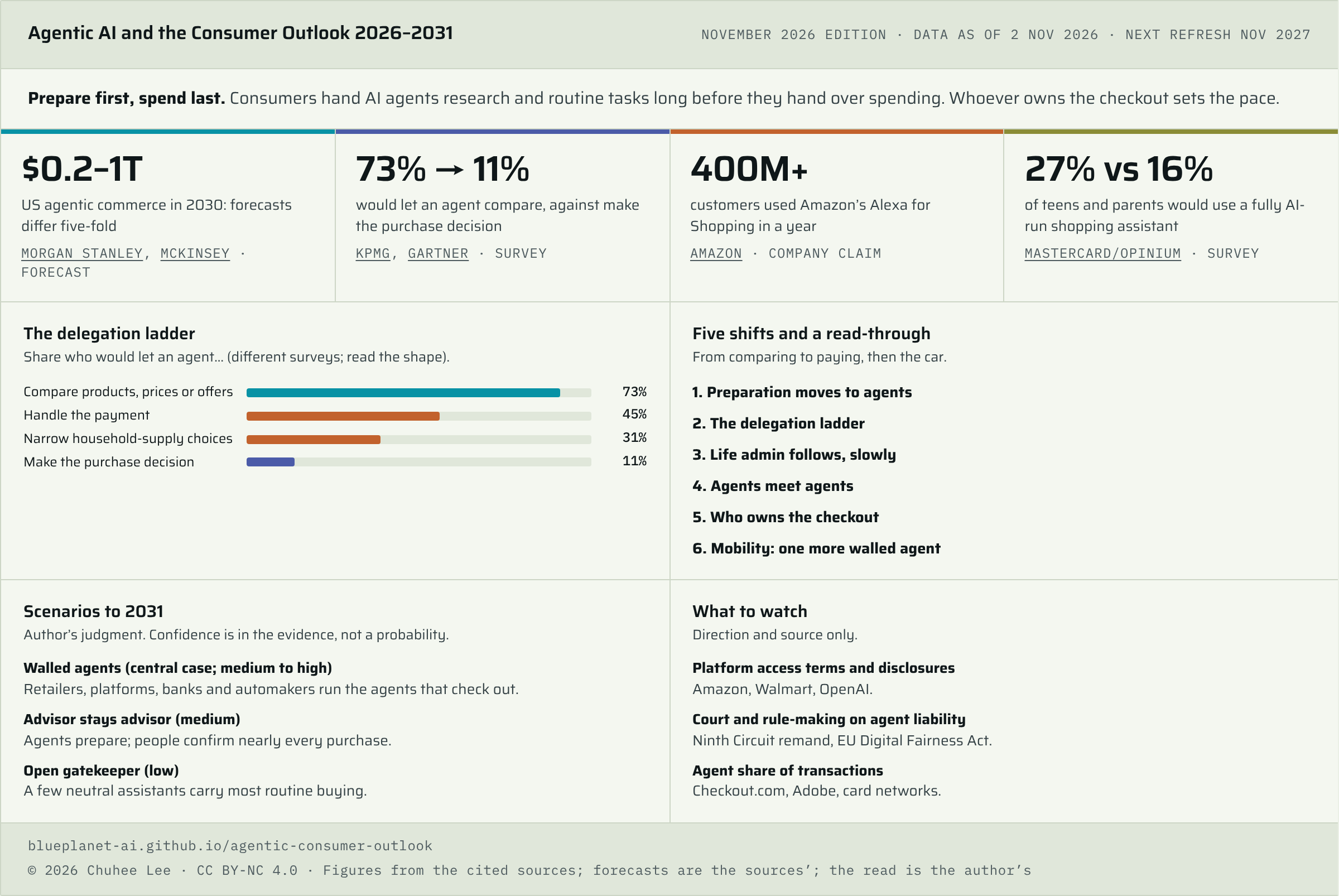
One-page summaryHeadline findingConsumers will let AI agents prepare their purchases long before they let them spend. By 2031 the big platforms, banks and automakers that own the checkout, not consumer trust alone, set how far delegation goes.
Summary
The short versionConsumers will hand AI agents the preparation of their purchases and errands long before they hand over the spending. Through 2031 the evidence points to a ladder: research and comparison first, routine and reversible tasks next, payment inside limits after that, and open-ended buying last. How far up the ladder people go depends less on trust in the model than on who owns the checkout and the access rules, because the big platforms, banks and automakers are writing those rules for their own agents. The author’s central case is “Walled agents”.
Forecasts differ five-fold, and count different things.
For 2030 McKinsey sees up to 1 trillion dollars of US goods revenue orchestrated by agents; Morgan Stanley sees 190 to 385 billion dollars, about 10% to 20% of online retail. Mastercard’s futurists expect more than 1 in 10 online shoppers to use agents routinely. None is a measurement.[3][4][11]
Platforms are building walls.
Amazon says its Alexa for Shopping reached more than 400 million customers in a year; Walmart’s terms require a human consent step before checkout unless an outside agent goes through Walmart’s own gateway; OpenAI moved its checkout into merchant apps. A US appeals court meanwhile treated a shopping agent as the user’s tool.[7][8][9][10]
Agents are easy to steer.
In Microsoft’s simulated marketplace agents often picked the first proposal they received, and Wharton’s roughly 26,000 tests found a source screenshot could swing a choice. These are simulations, not field losses, but they explain why consumers and regulators want limits.[12][13]
The car follows the phone.
In-car agents are on automaker roadmaps (Volkswagen Group in China from 2026, a multi-agent cockpit in 2027) and 63% of in-market US car shoppers already plan to use AI for research. Evidence of consumers buying or paying through a car agent is still almost absent.[14][15]
The delegation ladder: willingness drops with each step
Share of consumers · KPMG and Gartner surveys
Different surveys, samples and wording; read the shape, not the gaps between single bars. KPMG does not state its sample or countries.[1][2]
Where we are now
In late 2026 agents help people find and compare; the money still moves through people, and the measured numbers are small or come from the companies selling them.
Usage claims are large and soft. Amazon reported that Alexa for Shopping was used by more than 400 million customers in the last 12 months, that interactions rose 570%, and that users spend 50% more per order. The comparison is between users and non-users, so it does not show the agent caused the larger orders, and no sales figure was given.[7][8] Checkout.com’s self-reported merchant data put agent involvement at about 3% of transactions, with “involve” undefined.[16] Ant Group says its Alipay AI Pay handled more than 120 million transactions in one week in February 2026; the term is undefined and the figure unaudited.[17]
Willingness stops short of autonomy. Gartner’s May 2026 survey found 11% of consumers would let AI make a purchase decision and 31% would let it narrow household-supply choices; in a larger sample 54% double-check AI answers and 62% say AI wasted their time.[2] In the Worldpay research for the US, 45% say they are open to AI shopping, and of those 59% want to approve every purchase.[18] Across seven markets in the Global Payments survey, 33% of all respondents want to approve each payment.[19]
Money rails exist; usage is thin. Visa’s Trusted Agent Protocol (October 2025), Mastercard Agent Pay, Google’s Agent Payments Protocol (AP2, now at the FIDO Alliance since April 2026) and OpenAI’s Agentic Commerce Protocol (a one-time delegated payment with a maximum amount and an expiry) all let an agent pay inside limits the user sets.[20][21][22] Onchain agent payments are mostly machine-to-machine micro-payments, not consumer shopping.[23]
The legal footing changed in August. The Ninth Circuit vacated the injunction that had stopped Perplexity’s shopping agent on Amazon, holding that for the access question the agent acts as the user’s tool, in a narrow ruling that creates no new regime for agentic AI.[10]
Five-year forecasts for 2030 disagree by a factor of five
US agentic commerce, 2030 · US dollars
Scopes differ: McKinsey counts B2C goods revenue “orchestrated” by agents and excludes B2B; Morgan Stanley counts US e-commerce. Both come from firms that sell research or strategy on the topic. Gartner’s separate 15 trillion dollar B2B figure for 2028 gives no method and is not a consumer forecast.[3][4][24]
Preparation moves to agents
Search, comparison and shortlisting are the first tasks consumers give away, because they cost little to get wrong and the person still decides.
What people say. 73% of respondents in KPMG’s 2026 snapshot could see using an agent to compare products, prices or offers, and 64% prefer a general generative AI to a retailer’s or manufacturer’s own (7%).[1] Forrester found buying inside answer engines had the lowest adoption of the use cases it measured, while 35% of Gen Z, 32% of Millennials and 23% of Gen X online adults had used ChatGPT in the past month to search for products.[25]
What forecasters say. Global Payments and Lantern asked 8,027 consumers in seven markets in May 2026 and found they expect AI to make 15% of their own purchases within five years, up from 9% a year earlier; comfort with AI spending up to 50 dollars on cinema tickets rose from 32% to 82%.[19] The survey is sponsored by a payments company and records expectations, not behavior. Mastercard’s futurists predict more than 1 in 10 online shoppers, over 300 million, will use agents routinely by 2030.[11]
Where it already reaches the showroom. Cox Automotive’s tracker finds 63% of in-market US car shoppers plan to use AI in their search, while 71% of dealers have not adjusted their processes.[15]
Expected share of own purchases made by AI in five years
Percent of purchases · Global Payments and Lantern, 8,027 consumers in seven markets
An expectation, not a measure. Comfort with AI spending up to $50 on cinema tickets rose from 32% to 82% in the same year.[19]
The delegation ladder
Consumers climb from comparing to approving, then to acting within limits; each rung costs trust, and most people stop where the cost of a mistake becomes theirs.
The rungs. The stated-willingness data form a ladder. Comparing is acceptable to most; letting an agent narrow choices is acceptable to about a third; letting it decide the purchase to about one in ten.[1][2] Control is the condition: Synchrony’s survey with Oxford Economics found consumers open to AI doing more only if they feel protected, in control and able to approve the final decision, and KPMG found 79% want to step in at any time and 72% call rules, budgets and exclusions key.[26][1]
The young climb further, in what they say. In Opinium’s survey for Mastercard, 27% of teens against 16% of their parents would likely use a fully AI-run shopping assistant, and 31% of teens would trust AI recommendations over a friend’s (13 European markets, 26,000 respondents).[11] The author reads this as the leading indicator, with the caveat that attitude is not behavior.
Why people hold back. A 72-person eye-tracking experiment found that letting an assistant act on the user’s behalf shortened task time but raised unease and overrides and lowered trust and perceived control; a preview with a rationale eased the penalty.[27] Among 301 experts in Elon University’s canvass, 44% expect individual agency to change more negatively than positively by 2035 and 48% expect confidence in people’s native abilities to fall, while 40% expect better decision-making.[28] A survey of 666 respondents found frequent AI use correlated with lower critical-thinking scores; correlation, not cause.[29]
Teens lead their parents on full delegation
Likely to use a fully AI-run shopping assistant · Opinium for Mastercard, Jun–Jul 2026
13,000 parent-and-teen pairs across 13 European markets. The payer commissioned the survey and sells payments.[11]
Life admin follows, slowly
Agents will take over bookings, renewals and paperwork where rules are clear, but the evidence is thin and the regulators are cautious.
Travel and services are the early cases. Priceline says its Penny assistant now handles bounded travel-service tasks end to end; this is a vendor claim with no outcome data.[30] The UK Competition and Markets Authority calls adoption a “staged transition”, finds consumer-facing use limited, and says a fully autonomous personal agent is highly uncertain and many initiatives may be delayed, re-scoped or abandoned.[31]
Finance is where rules bite. The FCA’s Mills Review reports 20% of UK retail-finance consumers likely to use autonomous AI within preset goals (Yonder, more than 5,000 adults, April 2026).[32] The Bank of England found 80% of firms it surveyed have agents deployed, but only 2% with broad autonomy.[33] In the US, error-resolution duties under Regulation E were written for people, not agents, and the CFPB’s personal financial data rights rule is being reconsidered.[34][35]
The evidence gap. No source found measures time saved, errors or complaint rates for agents doing consumer admin. Everything above is willingness, vendor claims or regulator caution. The report treats this chapter as a hypothesis for the next refresh.
Agents meet agents
Once buyers and sellers both use agents, outcomes depend on speed, framing and what each side reveals; early studies are simulations, but they point to the same weak spots.
Order and speed beat quality. In Microsoft and Arizona State’s open-source marketplace, customer agents often accepted the first proposal they received (60 to 100% in tested settings), several models were manipulable, and quality did not protect sellers from slower rivals.[12] Wharton’s roughly 26,000 simulated runs found source order, injected memory and a source screenshot could shift an agent’s choice, in one case by 99 percentage points.[13]
Delegation can leak. A preprint found sellers’ agents could infer a buyer agent’s willingness to pay from the conversation alone, even with no stated budget.[36] Another found joint platform and seller learning cut simulated consumer surplus by 37.1%.[37] Both are preprints in stylized models.
Real-world tests exist but are anecdotal. Guardio’s Scamlexity test showed an agentic browser completing a purchase on a fake store, which is how the security case is made today; no source found gives field loss rates.[38] Academic lawyers argue agents concentrate power and weaken deliberation, and propose labels and sunset clauses; economists Hadfield and Koh warn that opaque goals and correlated errors could make an economy of agents fragile.[39][40]
Simulated customer agents often take the first offer
Share of choices going to the first proposal received · Magentic Marketplace
Range across tested settings and models, drawn at its top. A simulation with synthetic customers and businesses; results depend on the model version.[12]
Who owns the checkout
The platforms, banks and automakers that hold the customer and the payment are writing the rules; the court and the standards bodies pull the other way.
The walls. Amazon says its own agent will be the primary shopping agent on Amazon, and blocked Meta’s Muse agent in September 2026.[8][16] Walmart’s agentic access terms of 21 October 2026 require a human consent step before checkout unless an outside agent uses Walmart’s Agent Gateway, which supports per-transaction limits and category restrictions.[8] OpenAI moved Instant Checkout into merchant apps in March 2026.[9] Independent analyst Eric Seufert calls third-party agentic commerce a mirage because platforms have an insurmountable advantage, an opinion relayed through a secondary source.[8]
The openings. Google’s Universal Cart works across merchants, and AP2, now at the FIDO Alliance with Mastercard’s Verifiable Intent, is designed so any agent can reach any merchant with a signed mandate.[41][21] The Ninth Circuit held that for the access question an agent is “a tool, not a person”, narrow but favorable to user-chosen agents.[10] In China Alibaba opened all of Taobao to its Qwen assistant, and Ant’s Alipay platform connects its Ah Bao agent to more than 10,000 services, five phone brands with more than 70% share and 16 automakers.[42][43]
The liability gap. Fed Governor Waller named buyer-seller trust the main obstacle to agentic commerce; 93% of merchants in a PYMNTS survey say the agent provider should bear the loss when an agent buys wrongly, and only 28% would offer agents their full range on the same terms.[16] CERRE argues EU consumer law implicitly assumes a human buyer, and the Digital Fairness Act proposal expected this quarter was not described in Parliament’s briefing as covering agents.[44][45]
Mobility: the car as one more walled agent
In-car agents will do bounded, reversible tasks first, run by the automaker with a payments partner; buying a car stays a human decision with an AI researcher.
Roadmaps, not outcomes. Volkswagen Group announced an in-car agent for China in 2026 and a multi-agent cockpit in 2027.[14] In China Tesla added Alipay in-car parking payments in October 2026, and Ah Bao already connects to 16 automakers.[46][43] The author’s own benchmark shows how far current in-car assistants are from reliable multi-step action.[47]
Car buying. 63% of in-market US shoppers plan to use AI for research; 71% of dealers have not adjusted. The research is moving to general assistants, while the transaction (financing, trade-in, delivery) is still done with a dealer.[15]
What is missing. No source found measures consumers booking, paying, charging or servicing through a car agent. Claims by other automakers could not be verified and are left out.
Scenarios to 2031 and what would change them
Walled agents is the best-supported story; advisor-stays-advisor is the floor; an open neutral gatekeeper is the least supported.
How good are such forecasts? The closest precedent is voice shopping. In 2018 OC&C forecast 40 billion dollars of US and 5 billion of UK voice shopping by 2022, while The Information reported that about 2% of Alexa owners had bought by voice (Amazon disputed the figure).[5][6] The 2022 outcome was not found, so the lesson is about method, not result: forecasts of a new buying habit started from device counts and assumed willingness that stated surveys did not support. The 2030 agentic forecasts above come from firms with a stake in the answer.
| Scenario | What 2031 looks like | Evidence for | Evidence against | Confidence |
|---|---|---|---|---|
| Walled agents central case | Retailers, platforms, banks and automakers run their own agents. Outside assistants research and refer; they check out only through gateways with limits and consent steps. | Amazon’s primary-agent stance and Muse block; Walmart’s consent rule and gateway; OpenAI’s checkout move; Taobao and Alipay in China. | Ninth Circuit “tool” reasoning; open protocols (AP2, UCP, ACP); Google’s cross-merchant cart. | Medium to high |
| Advisor stays advisor | Agents research and prepare; people confirm nearly every purchase. Agent-initiated payments stay a low single-digit share of spending. | Autonomy cliff in surveys (11%, 31%); Forrester’s adoption finding; about 3% of transactions involve agents; voice-shopping precedent. | Ant’s claimed 120 million weekly transactions; Amazon’s 50% higher order value; fast rise in comfort with small spends. | Medium |
| Open gatekeeper | A few neutral assistants act on user mandates across merchants and carry most routine buying. | Mastercard’s 1 in 10; Morgan Stanley’s 10 to 20% share; AP2 mandates; user-tool ruling. | Platform access terms; liability unresolved; low stated willingness for autonomy; simulations show manipulation. | Low |
Confidence describes how well the evidence supports each story, not a probability. All three research lanes ranked Open gatekeeper lowest.
What would change the picture
Amazon v. Perplexity on remand and other access suits
A ruling confirming that a user may send their own agent would help the open gatekeeper case.[10]
Share of transactions initiated by agents
Checkout.com, Adobe and card-network data. A share well above low single digits would challenge “advisor stays advisor”.[16]
Method, limits and flags
Read before citingQuestion. How will AI agents change what consumers research, delegate and buy by 2031, and who decides how far that goes?
Scope. US consumers first, with the EU, the UK and China as comparison. General consumer lens with a mobility chapter. B2B agentic spending appears only where a forecast mixes it in.
Sources. Research papers, regulators and courts first, then analyst and consultancy forecasts, company disclosures and major trade publications. Each reference carries its type and date. Observed, survey, company and forecast figures are kept apart and labeled.
How the research was done. An earlier edition (October 2026, a 2027 outlook focused on current statistics) is replaced by this one; its verified findings are condensed into chapter 1. For the forecast, Claude, Gemini and ChatGPT each answered the same written brief, Claude compared the three files, opened the primary pages behind new figures, and ran a second targeted pass on automotive, track record, UK finance regulators and expert views. Framing, the five shifts, the scenarios and conclusions are the author’s.
What this report is not. The “author’s forecast” boxes and the three scenarios are judgments based on the evidence cited. Confidence labels describe how well the evidence supports a statement, not a probability. Signposts give a direction and a source, not a numeric threshold.
Flags and open questions
- Forecasts and surveys, not measurements. The report leans on what analysts, researchers and companies forecast to 2030–2031 and on consumer surveys; it does not require each claim to be validated by an independent third party. Many forecasters sell to the industries they forecast (McKinsey, Gartner, Morgan Stanley, Mastercard, Global Payments, KPMG, Cox), and company figures (Amazon, Ant, Checkout.com, Priceline) are claims. Each is labeled.
- Research round with Gemini and ChatGPT. Both models answered the same written brief as Claude. Claude opened the sources behind every new figure used here. The round changed the central case: all three lanes ranked an open, neutral assistant that carries most buying lowest.
- Corrections from that round. A Gemini figure set attributed to a systematic review (82% allow research, 41% cart staging, 9% unprompted purchase) could not be traced: the paper it names is a 72-person eye-tracking study with none of those numbers. A forecast that over half of top merchants would accept AP2 by 2028 appears in neither the FIDO Alliance page nor the trade report. The 120 million weekly transactions are Ant’s figure for Alipay AI Pay in February 2026, not for the Ah Bao assistant launched in June. The FTC click-to-cancel rule was vacated on 8 July 2025, and the CFPB data-rights rule is under reconsideration; neither is an operative duty for AI agents.
- Not used because not verified. Claims that Apple and Google hard-code biometric confirmation at checkout; BMW and Mercedes in-car agent claims; a Princeton and University of Washington study of sponsored flights (seen only in a secondary report); Booking Holdings’ investment in Vayo; and the “under four minutes” detail in Guardio’s test could not be confirmed and are left out.
- Secondary reports. Where the primary page could not be opened, a named secondary source is cited: Amazon’s and Walmart’s claims via FourWeekMBA; Checkout.com, PYMNTS and Waller via FinTech Weekly; Tesla and Alipay via The Paypers. The KPMG snapshot gives neither sample size nor countries. Worldpay’s and the FCA’s survey figures come from the publishers’ summaries.
- Preprints and simulations. Magentic Marketplace, Wharton’s technical report, Alavi and Nozari, and Affonso are simulations or preprints with synthetic buyers; they show where agents are weak, not how often consumers lose. Gerlich’s link between AI use and critical thinking is correlational.
- Baseline. Amazon’s comparison of users and non-users does not show the agent caused larger orders. Checkout.com’s 3% and Ant’s 120 million transactions have undefined terms.
- Thin or missing. No source found for: consumers buying, paying or servicing through a car agent; measured time saved or error rates for life-admin agents; the 2022 dollar outcome of the 2018 voice-shopping forecasts; a Delphi study or probability-sample expert survey on agentic commerce to 2030; causal evidence on wellbeing; field data on fraud or loss from agent purchases.
Change log
- November 2026 edition
- ChangedReplaces “Agentic AI and the Consumer: 2027 Outlook” (October 2026). Rewritten as a five-year forecast to 2031 with a delegation ladder, five shifts, a mobility chapter and three scenarios. The old statistics are condensed into chapter 1. The address changed from /agentic-consumer-2027/ to /agentic-consumer-outlook/.
- UpdatedThe Ninth Circuit vacated the Amazon v. Perplexity injunction on 4 August 2026; OpenAI moved Instant Checkout into merchant apps in March 2026; Amazon’s Rufus gave way to Alexa for Shopping.
- AddedMorgan Stanley and Global Payments forecasts, Walmart’s access terms, the Wharton and Magentic simulations, CMA, FCA and Bank of England material, Cox Automotive’s tracker.
About this report
Personal research by Chuhee Lee. Research, source verification and drafting were carried out with several AI models, including Claude (Anthropic), Gemini (Google) and ChatGPT (OpenAI). Every factual claim is sourced to the references listed below; topic selection, framing and conclusions are the author’s. These are personal views, not those of any employer.
References
- [1] KPMG — Consumer Snapshot: when AI does our shopping for us (sample and countries not stated)vendor survey · Oct 2026
- [2] Gartner — Survey finds consumers want AI shopping help, but not AI purchase decisionsanalyst survey · 27 May 2026
- [3] McKinsey — The agentic commerce opportunity: how AI agents are ushering in a new era for consumers and merchantsconsultancy forecast · 17 Oct 2025
- [4] Morgan Stanley — Agentic commerce impact could reach $385 billion by 2030bank research · 8 Dec 2025
- [5] TechCrunch — Voice shopping estimated to hit $40 billion across US and UK by 2022 (OC&C)forecast, baseline · 2 Mar 2018
- [6] Retail Dive — Only 2% of Alexa users reportedly purchase off the devices (The Information)secondary (leak, disputed by Amazon) · 8 Aug 2018
- [7] Amazon — Third quarter 2026 resultsprimary (company) · 29 Oct 2026
- [8] FourWeekMBA — Amazon says 400M used its AI agent; Walmart gates other botssecondary (relays company terms) · 30 Oct 2026
- [9] Digital Commerce 360 — OpenAI shifts checkout planssecondary · 6 Mar 2026
- [10] Amazon.com Services LLC v. Perplexity AI, No. 26-1444 (9th Cir.)primary (court opinion) · 4 Aug 2026
- [11] Mastercard — Report predicts one in 10 people will routinely use AI agents to shop and pay by 2030 (with Opinium teen–parent survey)company report, futurists' view · 8 Sep 2026
- [12] Bansal et al. (Microsoft, ASU) — Magentic Marketplace: an open-source environment for studying agentic marketspreprint, simulation · 27 Oct 2025
- [13] Kumar et al., Wharton — Agentic shopping is complicated and contingenttechnical report, simulation · 27 Aug 2026
- [14] Volkswagen Group — Auto China 2026: agentic AI roadmap for Chinaprimary (company roadmap) · Apr 2026
- [15] Cox Automotive — AI in Auto Retail tracker (63% of in-market shoppers plan to use AI; 71% of dealers have not adjusted)vendor tracker · Aug 2026
- [16] FinTech Weekly — Agentic commerce: launch month, liability and risk (Checkout.com, PYMNTS, Waller, Amazon–Muse)secondary · Sep–Oct 2026
- [17] NIQ — 120 million AI Pay transactions in a single week (Ant Group figure, unaudited)company claim via vendor · 30 Jul 2026
- [18] Worldpay — Agentic commerce report 2026vendor research · 2026
- [19] Global Payments — Consumers expect AI to make 15% of their purchases within five years (8,027 consumers, 7 markets)vendor research · 23 Sep 2026
- [20] Visa — Introduces Trusted Agent Protocolprimary (company) · Oct 2025
- [21] FIDO Alliance — Building the trust layer for agentic payments with AP2 and Verifiable Intentstandards body · 28 Apr 2026
- [22] OpenAI — Agentic Commerce Protocol: key concepts (delegated payment with maximum amount and expiry)primary (company documentation)
- [23] Visa with Artemis — Agentic payments from the ground upcompany-funded onchain data · updated 14 Jul 2026
- [24] Digital Commerce 360 — Gartner: AI agents will mediate $15 trillion in B2B purchases by 2028secondary (analyst forecast, no method) · 28 Nov 2025
- [25] Forrester — What it means that the leader in agentic commerce just pulled backanalyst view · 7 Mar 2026
- [26] Oxford Economics — The future of AI shopping depends on trust (Synchrony survey, 2,000 US consumers)sponsored research · 30 Sep 2026
- [27] Balaskas et al. — Acting on the user's behalf: trust and control with an AI assistant (Multimodal Technologies and Interaction 10(3):22; 72-person eye-tracking experiment)peer-reviewed, small experiment · 1 Mar 2026
- [28] Elon University — Being Human in 2035: methodology and topline findings (301 experts)academic expert canvass · 2025
- [29] PsyPost — AI tools may weaken critical thinking (Gerlich, 666 respondents; correlational)secondary summary · Jan 2025
- [30] Priceline — Penny goes fully agenticprimary (company claim) · 2026
- [31] UK CMA — Agentic AI and consumersprimary (regulator) · 9 Mar 2026, updated 30 Oct 2026
- [32] FCA — Landmark review of the impact of AI on retail financial services (Mills Review)primary (regulator) · 6 Jul 2026
- [33] Bank of England — Artificial intelligence in UK financial services 2026primary (regulator) · Oct 2026
- [34] Rail Governance — Regulation E error-resolution obligations for AI-initiated transferssecondary (legal analysis)
- [35] CFPB — Personal financial data rights (section 1033)primary (regulator)
- [36] Alavi and Nozari — When Agents Shop for You (abstract only)preprint, experiment · Apr 2026
- [37] Affonso — Vertical tacit collusion in AI-mediated marketssingle-author preprint, simulation · 2026
- [38] Guardio Labs — Scamlexity: agentic AI browsers put to the test (page not opened; test confirmed by trade press)vendor red-team test · Aug 2025
- [39] Public Citizen CLP Blog — Bartholomew and Becher, The End of Shoppinglegal scholarship, summary · 20 Oct 2025
- [40] Hadfield and Koh — An economy of AI agents (NBER Handbook chapter)academic chapter · Sep 2025
- [41] Google — Universal Cart launchprimary (company) · May 2026
- [42] Alibaba Group — Alibaba opens all of Taobao to Qwen AIprimary (company) · 11 May 2026
- [43] TechNode — Alipay launches agentic commerce platform in Chinasecondary · 18 Aug 2026
- [44] CERRE (Busch) — Agentic AI and consumer protectionthink-tank paper · 16 Jul 2026
- [45] EPRS — Towards a digital fairness actprimary (EU Parliament service) · 5 Oct 2026
- [46] The Paypers — Tesla partners with Alipay to add in-car parking payments in Chinasecondary · Oct 2026
- [47] Chuhee Lee — In-Car AI Assistant Benchmark, October 2026 editionown report · 11 Oct 2026
- [48] Chuhee Lee — Mobility Product Outlookown report