Chuhee Lee

At a glance
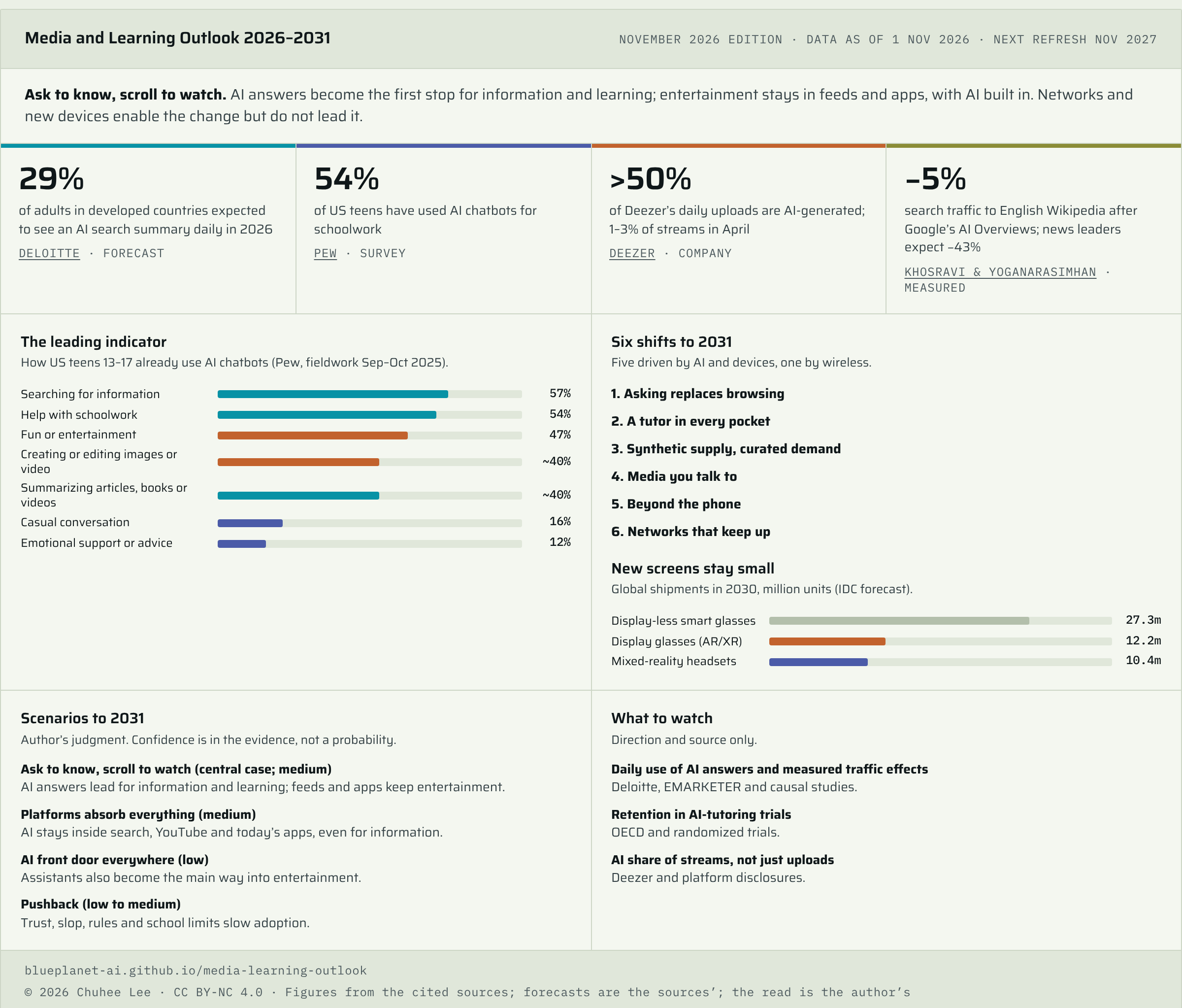
One-page summaryHeadline findingExpert forecasts to 2031 point to a split in how people use media. For information and learning, people will increasingly ask an AI rather than look for themselves. For entertainment, AI works inside the feeds and apps they already scroll.
Summary
The short versionExpert forecasts to 2031 point to a split in how people use media. For information and learning, people will increasingly ask an AI rather than look for themselves. For entertainment, AI works inside the feeds and apps they already scroll: YouTube, Netflix, Spotify, games and Google itself. A growing share of what they get back will be made or remixed by AI. The author’s central case, “Ask to know, scroll to watch”, rests on that split. Faster networks and new devices enable it; neither is the main cause.
Asking replaces browsing, for information.
Deloitte expects about 29% of adults in developed countries to see an AI search summary every day in 2026, three times the share using a standalone AI app daily. Pew found users clicked a result on 8% of searches with an AI summary, against 15% without one. Measured effects are smaller than feared: AI Overviews cut search traffic to English Wikipedia by about 5%, while news leaders expect a 43% fall. Only 2% of US adults name an AI chatbot as a top-three news source.[1][2][3][9][10]
Learning becomes a conversation.
54% of US teens have used chatbots for schoolwork. A Harvard randomized trial found an AI tutor more than doubled learning gains against in-class active learning. But in a Turkish trial, students who practiced with a general chatbot scored 17% lower on a closed-book exam, and a tutor designed for learning only matched studying without AI.[4][5][6]
Supply turns synthetic; attention stays selective.
More than half of the tracks uploaded to Deezer each day are AI-generated, yet in April they drew only 1–3% of streams. McKinsey’s scenario puts around 60 billion dollars of annual US film and TV distribution revenue up for redistribution within five years of mass AI adoption.[7][8][11]
Media starts to talk back, mostly for the young.
72% of US teens have tried AI companions, and Americans spent about 705 million hours on companion apps in the first quarter of 2026, two and a half times their time on dating apps. Across all ages the picture is narrower: only 1.9% of ChatGPT messages are about relationships and 0.4% about games and role play.[12][13][14]
Devices and networks enable; they do not lead.
IDC forecasts 27.3 million display-less smart glasses and 12.2 million display glasses in 2030, small next to phones and TVs. Ericsson forecasts mobile traffic 2.5 times higher by 2031 and first 6G services around 2030. Google is launching audio glasses before display glasses. The bigger network change is the uplink, as AI and cameras send more data up.[15][16][17][18]
The leading indicator: how US teens already use AI chatbots
Share of teens 13–17 · Pew, fieldwork Sep–Oct 2025
“About 4 in 10” is drawn at 40%. About 3 in 10 teens use a chatbot daily.[4] The author reads teens as the leading indicator: habits formed now carry into adulthood by 2031.
Where we start in 2026
Media time is capped and already moving onto the TV set and creator platforms; AI arrives in a market that grows slowly in money and not at all in hours.
Time. Americans 15 and older watched 2.61 hours of TV a day in 2025, the largest single leisure activity in the federal time diary. Ages 15 to 19 watched 1.48 hours and spent 1.53 hours on games and computer leisure; ages 65 to 74 watched 4.20.[19][20] Hours are close to a ceiling, so every shift in this report is a shift of share.
Screens. In August 2026 streaming took 49.6% of US TV-set time and YouTube alone a record 15.8%.[21] 61% of US internet households use a smart TV as their main streaming device.[22] McKinsey’s US baseline shows linear TV viewing falling 4% a year from 2022 to 2024 while streaming grew 13% and social video 14%.[11]
Money. PwC forecasts global entertainment and media revenue of 4.2 trillion dollars in 2030, growing 3.4% a year. Advertising grows faster (5.6%) than consumer spending (2.5%), traditional TV shrinks 1.1% a year, and PwC names AI-driven personalization of advertising as a main growth engine.[23]
Share of US TV-set time, August 2026
Percent · Nielsen Gauge
YouTube is part of the streaming total. Nielsen changes its Gauge method from September 2026, so later months will not be like-for-like.[21]
Asking replaces browsing
For information, news and how-to learning, AI answers become the front door; for entertainment, the evidence points to AI inside the feeds people already use.
What experts forecast. Deloitte predicts that daily use of AI inside search will be three times daily use of any standalone AI tool in 2026: about 29% of adults in developed countries will see at least one AI search summary a day, and about 10% will use a standalone AI app daily.[1] Ericsson’s 2026 consumer survey across 27 markets finds 38% of smartphone users expect to hand daily tasks to AI by 2030, against about 4% using agentic AI today, and heavy AI users rising from about 10% to about 30% of smartphone users.[24]
What it does to media. In Pew’s browsing panel, 8% of visits with an AI summary led to a click on a result, against 15% without one, and 26% of those pages ended the session.[2] Google search traffic to more than 2,500 news sites worldwide fell 33% in a year (Chartbeat data), media leaders expect a further 43% fall over three years, and 76% plan to push journalists to behave more like creators, with YouTube their top off-platform priority.[9]
Smaller and more Google-shaped than feared. A causal study using the staggered rollout of Google’s AI Overviews found they cut search traffic to English Wikipedia by 5.45% (4.82% with a different comparison), an order of magnitude below publishers’ expectations.[3] In a study of 11,500 real queries, AI Overviews appeared on 51.5% of them and drew on sources that overlapped little with the organic results, leaning toward Google-owned content such as YouTube.[25] EMARKETER forecasts almost 190 million US users of AI tools by 2030, with Google’s Gemini and AI Mode passing ChatGPT in users in 2027.[26] For news, only 2% of US adults name an AI chatbot as a top-three source and 7% rely on AI tools a great deal or a fair amount.[10]
Learning and leisure too. More than 70% of ChatGPT messages are now not about work, and 10.2% are requests for tutoring or teaching.[14] 57% of US teens have used chatbots to search for information and about 4 in 10 to summarize articles, books or videos.[4]
Clicks when an AI summary appears
Share of Google search visits with a click · 900 US adults · Pew, March 2025
Google called the study’s method flawed and its queries unrepresentative.[2]
Expected against measured traffic loss
Change in search referrals · Reuters Institute survey of news leaders; causal estimate for Wikipedia
Different sites and measures: news publishers’ three-year expectation against a measured effect on an encyclopedia. The gap shows how much of the fear is not yet in the data.[9][3]
A tutor in every pocket
Self-directed learning moves from searching and watching to conversing with an AI tutor; the evidence says designed tutors teach, while general chatbots mostly help people finish tasks.
Adoption is already broad. 54% of US teens have used chatbots for schoolwork and 10% do all or most of it with chatbot help. About a third of teens think AI would teach a skill better than a person, the only task Pew asked about where more teens favored AI.[4] Duolingo, whose paid tier now includes an AI video-call tutor, reported 58.7 million daily users in the second quarter of 2026, up 23% in a year.[29]
The best evidence is strong but narrow. In a Harvard physics course, a randomized crossover trial with 194 students found learning gains with a custom AI tutor more than double those of in-class active learning, an effect of 0.73 to 1.3 standard deviations, in a median 49 minutes. The tutor was fed the professors’ pre-written step-by-step solutions; it was one course, one session per topic and no test of retention.[5] In Nigeria, a six-week, teacher-guided after-school program using GPT-4 in nine public schools raised scores on its final assessment by 0.31 standard deviations (0.23 for English) and by 0.21 on the regular end-of-term exam. Only 759 of 1,328 assigned students sat the final test, and the largest gains went to stronger students.[30]
The warning is just as clear. In a randomized trial with about 1,000 Turkish high school students, cited in the OECD’s Digital Education Outlook 2026, access to GPT-4 raised math practice scores by 48% (general chatbot) and 127% (tutor designed for learning). On a closed-book exam afterwards, the general chatbot group scored 17% lower than students who never had AI, and the tutor group scored about the same as them. Students using the general chatbot did not notice they had learned less.[6][31] The OECD warns that AI used without teaching guidance may improve performance without real learning gains.[31]
Experts lean hopeful but split. In Elon University’s canvassing of about 300 technology experts, 42% expect AI to change curiosity and the capacity to learn for the better by 2035 and 29% for the worse, while 50% expect the capacity to think deeply to get worse.[32]
Performance is not learning
Math scores against students without AI · Türkiye, ~1,000 students · randomized trial
The −17% bar shows the size of a drop. The tutor group’s exam result was not statistically different from zero.[6]
Synthetic supply, curated demand
AI multiplies the supply of music, video and stories far faster than demand; human creators, labels and recommendation systems decide what gets watched.
Supply. Deezer said in July 2026 that more than half of its daily uploads are AI-generated, about 90,000 tracks a day; in April the share was 44% and the volume about 75,000.[7][8] YouTube says more than a million channels used its AI creation tools every day in December 2025, and it plans tools to make Shorts with your own likeness, simple games from a text prompt, and music.[34] Netflix is using AI for recommendations, ad formats and production, and said in April it would add a vertical mobile feed that carries video podcasts.[35]
Demand. In April, AI tracks drew only 1–3% of Deezer streams, and 85% of those streams were flagged as fraud. In Deezer’s survey 97% of respondents could not tell AI music from human music, and 80% wanted AI tracks labeled.[8] On a fresh YouTube account, Kapwing counted 21% of the first 500 Shorts as AI-generated “slop”; YouTube has made reducing such content a 2026 priority.[36][34]
Money. McKinsey estimates AI could touch workflows behind about 20% of original content spend within five years and that, if AI use overtakes incumbent technology, around 60 billion dollars of annual US distribution revenue could be redistributed within five years of mass adoption. In its scenario, open platforms gaining 5% more of US TV and film viewing hours would cut distribution revenue by 13.2 billion dollars and add 7.5 billion to the platforms. It also notes AI output is not yet of premium production quality.[11] Deloitte expects generative video to empower independent creators, and microdrama in-app revenue to roughly double to 7.8 billion dollars in 2026.[1]
Retreats. OpenAI discontinued its Sora app in 2026, and Disney left a planned 1 billion dollar investment and character license with it.[37][38]
AI music on Deezer: uploads against listening
Percent · company figures
The streams bar is drawn at the 2% midpoint of the reported 1–3% range.[7][8]
Media you talk to
Entertainment becomes two-way: AI companions, interactive characters and prompt-made games grow fastest among the young; fully generated games stay early.
Companions are already mass. 72% of US teens have tried an AI companion and 52% use one regularly; entertainment is the most common reason (30%).[12] Sensor Tower data put US time in AI companion apps at about 705 million hours in the first quarter of 2026, against about 280 million in dating and social discovery apps.[13] 47% of US teens have used chatbots for fun or entertainment.[4]
But it is concentrated. In a study of about 1.1 million ChatGPT conversations, only 1.9% of messages were about relationships and personal reflection and 0.4% about games and role play.[14] MIT and OpenAI found emotional engagement absent from most ChatGPT conversations and concentrated in a small group of heavy users; voice use was linked to better wellbeing when brief and worse outcomes with prolonged daily use.[39]
Interactive worlds are early. Google DeepMind’s Genie 4 world model lets people create and change explorable worlds by text while they play, but it supports only “a few minutes of continuous interaction” and is in a research preview for testers.[40] Game makers are wary: 52% of professionals in GDC’s 2026 survey said generative AI is hurting the industry and 7% said it helps, though 36% use it.[41] YouTube plans text-to-game tools in 2026.[34] Newzoo forecasts players rising from 3.70 billion in 2026 to 4.07 billion in 2029.[42]
US time in AI companion apps against dating apps
Hours per quarter · Sensor Tower via OfficeChai
Vendor app-panel data; methods not published with the figures.[13]
Beyond the phone
New devices add an always-listening AI layer around the phone and TV rather than replacing them; display glasses stay small through 2030.
Glasses. IDC forecasts display-less smart glasses rising from 13.6 million units in 2026 to 27.3 million in 2030, display glasses from 3 million to 12.2 million and mixed-reality headsets from 3.2 million to 10.4 million.[15] ABI Research expects about 32 million consumer AR glasses in 2030, about 28 million of them without a display.[46] In the first half of 2026, 96% of AI glasses shipped had no display.[47] Google’s first Android XR eyewear, with Samsung, Gentle Monster and Warby Parker, starts with audio glasses this fall; display glasses come later.[16] Most glasses, in other words, are cameras, microphones and speakers for an assistant, not screens for video.
Computers and new AI devices. Gartner expected AI PCs to be 55% of PCs shipped in 2026 and “the norm” by 2029.[48] OpenAI’s first device, designed with Jony Ive, is reported to be a 200 to 300 dollar smart speaker with a camera for early 2027, with glasses not before 2028.[49]
The TV stays central. The smart TV is the main streaming device for 61% of US internet households, while rising memory costs make TV price increases “unavoidable” in TrendForce’s forecast.[22][50]
Global shipments forecast, 2026 to 2030
Million units · IDC, June 2026 · bars show 2030
Global forecasts; they say nothing directly about US media time.[15]
Networks that keep up
Traffic keeps growing but networks are not the constraint in the US; the change that matters is upload, as cameras and AI send more data up.
Volume. Ericsson forecasts global mobile network traffic of 515 exabytes a month in 2031, about 2.5 times the end-2025 level, with smartphone use rising from 22 to 42 gigabytes a month. Video was about 75% of mobile data at the end of 2025.[17]
Direction. Uplink grew faster than downlink at 43 of 55 operators Ericsson studied, and its AI scenarios suggest uplink could be three times higher or more in 2031 than in 2025.[18]
Generations. Ericsson expects 6.4 billion 5G subscriptions and 180 million 6G subscriptions by 2031, with first 6G services around 2030 and early launches in markets such as the US, China, Japan and South Korea.[51][18] Dell’Oro expects Wi-Fi 7 in more than 90% of the Wi-Fi equipment market by 2029.[52] Wi-Fi 8 (IEEE 802.11bn), with certification planned for December 2027, targets 25% lower tail latency, 25% fewer dropped packets when roaming, and better device-to-device links such as phone to TV or headset to PC.[53] Most AI media and learning happens indoors, so home Wi-Fi matters as much as cellular. 96.9% of Americans can already get fixed broadband at 100/20 Mbps.[54]
Global mobile network traffic
Exabytes per month, including fixed wireless · Ericsson Mobility Report, June 2026
What holds it back
Seven forces slow the shifts: a fixed time budget, low trust, labeling and child-safety rules, schools pulling back, household budgets, the pull of live events and the cost of AI video.
| Force | Evidence | Effect on the shifts | Kind |
|---|---|---|---|
| Fixed time | 2.61 hours of TV a day, half of all leisure time.[19] | New AI media must take time from existing media. | Survey |
| Trust | 9% of US adults are extremely or very confident that information from AI, chatbots or search is reliable; 49% have little or no confidence. 39% say AI use in news would reduce their trust.[27][10] | Favors labeled, curated sources and human creators. | Survey |
| Labels and rules | EU AI Act Article 50 requires machine-readable marking of AI-generated content and disclosure of deepfakes from 2 August 2026 (2 December 2026 for systems already on the market); a California law and an FTC inquiry target companion chatbots for minors.[55][44][43] | Makes AI content visible; companion apps for minors face limits. | Observed |
| Schools | 33 states with K-12 phone bans or limits; OECD warns of performance without learning.[33][31] | Slows AI learning habits during school hours; shifts them home. | Observed |
| Budgets | 41% of US consumers cancelled a paid streaming video service in the past six months; PwC sees subscription fatigue and more bundling.[56][23] | AI features arrive inside ad tiers and bundles, not as new paid services. | Survey |
| Live and shared | Live and experience-led revenue grows 5.2% a year to 2030, faster than total media.[23] | Shared events keep value as personal AI media spreads. | Forecast |
| Economics of AI video | OpenAI closed Sora; Disney exited its deal.[37][38] | Generated video may stay a tool for creators, not a consumer app. | Company |
Scenarios to 2031
The author’s central case splits by purpose: ask to know, scroll to watch. Two alternatives push one side further; a pushback would slow both.
How good are such forecasts? Infrastructure forecasts have aged well: in 2020 Ericsson forecast 3.5 billion 5G subscriptions by the end of 2026, and it counted 3.1 billion by the first quarter of 2026, on track.[57][18] Forecasts of new behavior have not: in 2022 Gartner predicted that 25% of people would spend at least an hour a day in the metaverse by 2026.[58] This report therefore trusts network and device forecasts more than forecasts of new habits.
| Scenario | What 2031 looks like | Evidence for | Evidence against | Confidence |
|---|---|---|---|---|
| Ask to know, scroll to watch central case | AI answers, mostly Google’s and the big assistants’, are the first stop for information and how-to learning. Entertainment discovery stays in feeds and home screens, with AI inside YouTube, Netflix, Spotify and games. | 29% daily AI-summary viewers forecast for 2026; 54% of teens use chatbots for schoolwork; Google AI forecast to pass ChatGPT in users by 2027; 1M+ YouTube channels use AI tools daily. | Measured traffic loss so far is about 5%; only 2% name AI a top news source; learning gains need designed tutors. | Medium |
| AI front door everywhere | Assistants on phones, glasses and TVs also become the main way into entertainment; they can play and buy inside other apps. | Ericsson: 38% expect to delegate daily tasks by 2030; audio glasses favor asking; teen chatbot use for fun at 47%. | Platforms keep their apps closed; people browse rather than ask for entertainment; agentic use is expectation, not behavior. | Low |
| Platforms absorb everything | Even for information, AI stays inside search, YouTube and existing apps; standalone assistants stay niche. | Standalone AI app daily use about 10%; AI Overviews favor Google-owned sources; Sora closed. | ChatGPT-style assistants already handle many non-work questions and homework. | Medium |
| Pushback | Trust problems, “slop”, school limits and companion rules slow adoption; AI stays behind the scenes. | 9% extremely or very confident in AI information; EU labeling rules; FTC companion inquiry; 33 states limit phones in school. | Teen and companion usage is broad and rising; people use tools they say they distrust. | Low to medium |
Confidence describes how well the evidence supports each story, not a probability. The central case changed after the Gemini and ChatGPT research rounds: both rated AI inside existing platforms better supported than an AI front door for everything.
What would change the picture
Method, limits and flags
Read before citingQuestion. How will advances in AI, wireless communication and consumer devices change how people use media for entertainment and for self-directed learning by 2031?
Scope. US consumers first, with global forecasts where US-only ones do not exist. Media means video, audio, music, games, news, social and interactive formats. Learning means self-directed and lifelong learning; schools appear only where they shape consumer habits.
Sources. Research papers, research institutes and analysts’ forecasts first, then company disclosures and major news and trade publications. Each reference carries its type and date. Observed, survey, company and forecast figures are kept apart and labeled.
How the research was done. An earlier draft of this report, researched with Claude, Gemini and ChatGPT, measured US video viewing; its verified figures now form the 2026 baseline in chapter 1. For the forecast, Claude gathered expert forecasts, papers and news; Gemini (research papers, government, standards) and ChatGPT (analysts, companies, major publications) then answered the same written brief, and Claude verified and merged their findings. Framing, the six shifts, the scenarios and conclusions are the author’s.
What this report is not. The “author’s forecast” boxes and the four scenarios are judgments based on the evidence cited. Confidence labels describe how well the evidence supports a statement, not a probability. Signposts give a direction and a source, not a numeric threshold.
Flags and open questions
- Forecasts, not measurements. As agreed for this edition, the report leans on what analysts, researchers and companies forecast to 2030–2031 and does not require each claim to be validated by an independent third party. Many forecasters sell to the industries they forecast (Ericsson, IDC, ABI, Deloitte, McKinsey, PwC, EMARKETER), and company figures (Deezer, YouTube, Netflix, Duolingo, Google) are claims. Each is labeled.
- Research round with Gemini and ChatGPT. Both models answered the same written brief. Claude opened the sources behind every new figure used here. Their main effect was to change the central case: both rated AI inside existing platforms better supported than an AI front door for all media.
- Corrections from that round. The Turkish figures (+48%, +127%) measure practice with AI available, not learning; on the exam without AI the tutor group did no better than students without AI. The Nigeria result of 0.31 standard deviations is a composite (0.23 for English) from a teacher-guided program with high attrition. ChatGPT reported that 3% of US adults used AI as a news source in the past week; Gallup’s 3% refers to adults 50 and older, so the report uses Gallup’s 2% (top-three source) and 7% (rely on AI).
- Not used because not verified. Figures from a Qualcomm consumer survey, a Qualcomm readout of 3GPP 6G standards meetings, Omdia glasses shipments, an Omdia satellite direct-to-device forecast, IEA data-center electricity projections, an S&P Global Kagan glasses survey and a Google and Eedi tutoring trial could not be opened in full or confirmed, and are left out.
- Secondary reports. Where the primary page could not be opened, a named secondary report is cited: Pew’s AI-summary study via Search Engine Roundtable; Gartner’s AI PC forecast via ITPro; Sensor Tower via OfficeChai; Deezer’s April figures via AlternativeTo; the FTC orders and California SB 243 via DLA Piper; OpenAI’s device plans via MacRumors reporting The Information (not confirmed by OpenAI).
- Preprints and co-authors. The Wikipedia traffic study and the AI Overviews audit are preprints. The ChatGPT usage paper and the MIT study were co-authored by OpenAI researchers.
- Teen chart. Pew gives “about 4 in 10” for two uses; the chart draws them at 40%.
- Baseline. Nielsen changes its Gauge method from September 2026, so the August 2026 shares in chapter 1 will not compare directly with later months.
- Not found. No source found for: a forecast of US hours by medium to 2031; an independent measure of how much consumed media is AI-made; trials longer than a semester of adults learning with AI on their own; daily minutes of media or learning on smart glasses; how often people check content-provenance labels; US in-car media (see the site’s report on media on the move).
Change log
- November 2026 edition
- AddedFirst edition, data as of 1 November 2026. Rescoped before publication from a US video benchmark to a forecast of media and learning.
About this report
Personal research by Chuhee Lee. Research, source verification and drafting were carried out with several AI models, including Claude (Anthropic), Gemini (Google) and ChatGPT (OpenAI). Every factual claim is sourced to the references listed below; topic selection, framing and conclusions are the author’s. These are personal views, not those of any employer.
References
- [1] Deloitte — 2026 Technology, Media and Telecommunications Predictionsforecast (consultancy) · 18 Nov 2025
- [2] Search Engine Roundtable — Pew: Google users click less when an AI summary appears (900 US adults’ browsing, March 2025)secondary (Pew data) · 23 Jul 2025
- [3] Khosravi, Yoganarasimhan — Impact of AI Search Summaries on Website Traffic: Evidence from Google AI Overviews and Wikipedia (arXiv 2602.18455 v6)research paper (preprint) · 2 Sep 2026
- [4] Pew Research Center — How teens use and view AI (1,458 US teens age 13–17; fieldwork 25 Sep–9 Oct 2025)primary (probability panel) · 24 Feb 2026
- [5] Kestin, Miller, Klales, Milbourne, Ponti — AI tutoring outperforms in-class active learning: an RCT (Scientific Reports 15, 17458; Harvard, n=194)peer-reviewed RCT · 3 Jun 2025
- [6] Bastani, Bastani, Sungu, Ge, Kabakcı, Mariman — Generative AI Can Harm Learning (SSRN 4895486; randomized field experiment, ~1,000 high school students, Türkiye)research paper (RCT) · 2024
- [7] TechCrunch — Music streamer Deezer says more than 50% of daily uploads are AI-generatedsecondary (company figures) · 21 Jul 2026
- [8] AlternativeTo — Deezer says 44% of daily uploads are AI-generated but only represent about 1–3% of streamssecondary (company figures) · Apr 2026
- [9] University of Oxford — News publishers expect search traffic to fall more than 40% in the next three years (Reuters Institute, Journalism, Media and Technology Trends and Predictions 2026; 280 leaders, 51 countries)research institute survey · 13 Jan 2026
- [10] Gallup — Use of AI to Get News in U.S. Is Rare (Gallup Panel, 2,062 US adults, 4–17 May 2026)primary (probability panel) · 23 Jun 2026
- [11] McKinsey — What AI could mean for film and TV production and the industry’s future (Vickers, Brodherson, Wrubel, Bernard)consultancy scenarios · 23 Jan 2026
- [12] TechCrunch — 72% of US teens have used AI companions, study finds (Common Sense Media with NORC; 1,060 teens, Apr–May 2025)secondary (nonprofit survey) · 21 Jul 2025
- [13] OfficeChai — Americans spend twice as much time on AI companions as on dating apps (Sensor Tower, State of AI 2026)secondary (vendor data) · 17 Jun 2026
- [14] Chatterji, Cunningham, Deming, Hitzig, Ong, Shan, Wadman — How People Use ChatGPT (NBER Working Paper 34255)research paper · Sep 2025
- [15] IDC — Smart glasses surge: the XR market is rewriting its own rulesanalyst forecast · 15 Jun 2026
- [16] Google — Intelligent eyewear with Gemini is coming this fall (Google I/O 2026)company announcement · 19 May 2026
- [17] TelecomLead — Ericsson Mobility Report 2026: global mobile data traffic to reach 515 EB by 2031secondary (vendor forecast) · 16 Jun 2026
- [18] Computer Weekly — Uplink traffic gains momentum as 5G subscriptions top three billion (Ericsson Mobility Report, June 2026)secondary (vendor forecast) · Jun 2026
- [19] U.S. Bureau of Labor Statistics — American Time Use Survey, 2025 results (USDL-26-1022)primary (federal survey) · 25 Jun 2026
- [20] U.S. Bureau of Labor Statistics — ATUS 2025, Table 11A: time spent in leisure and sports activities by selected characteristicsprimary (federal survey) · 25 Jun 2026
- [21] Nielsen — TV viewing cools off in Nielsen’s August Gauge as sports take a breather and school resumes (five-week interval, 27 Jul–30 Aug 2026)primary (measurement) · 22 Oct 2026
- [22] Parks Associates — 61% of US internet households use their smart TV as the primary streaming device (8,000 households)vendor research · 6 Jan 2026
- [23] PwC — Global Entertainment & Media Outlook 2026–2030 (global press release)forecast (consultancy) · 22 Jun 2026
- [24] Ericsson ConsumerLab — An Agentic Life: consumer AI agents through 2030 (43,000+ smartphone users, 27 markets)vendor research · 21 Sep 2026
- [25] Grossman, Liu, Chen, Smith, Borcea, Chen — How Generative AI Disrupts Search: An Empirical Study of Google Search, Gemini, and AI Overviews (arXiv 2604.27790)research paper (preprint) · 30 Apr 2026
- [26] EMARKETER — US GenAI Consumer Adoption Forecast H1 2026 (Nate Elliott, Cindy Liu)forecast (vendor) · 2026
- [27] AP-NORC Center — State of the Facts 2026 (AmeriSpeak, 1,036 US adults, 29 Jul–10 Aug 2026)primary (probability panel) · 9 Sep 2026
- [28] Chuhee Lee — Agentic AI and the Consumer Outlook 2026–2031 (this site)own report · Nov 2026
- [29] Pulse 2.0 — Duolingo daily active users reach 58.7 million (Q2 2026 results)secondary (company figures) · 10 Aug 2026
- [30] De Simone, Tiberti, Barron Rodriguez, Manolio, Mosuro, Dikoru — From Chalkboards to Chatbots: Evaluating the Impact of Generative AI on Learning Outcomes in Nigeria (World Bank Policy Research Working Paper 11125)research paper (RCT) · May 2025
- [31] OECD — Digital Education Outlook 2026: Exploring Effective Uses of Generative AI in Educationintergovernmental report · Jan 2026
- [32] Elon University Imagining the Digital Future Center — Being Human in 2035: expert canvassing (301 experts, non-random, Dec 2024–Feb 2025)expert canvassing · Apr 2025
- [33] Ballotpedia News — Kansas becomes the 33rd state to enact a K-12 cellphone bansecondary (policy tracker) · 30 Mar 2026
- [34] Tubefilter — Neal Mohan’s 2026 letter to creators (YouTube CEO annual letter)secondary (company claims) · 21 Jan 2026
- [35] Net Influencer — Netflix to roll out vertical video feed and AI recommendations in mobile redesign (Q1 2026 results)secondary (company claims) · 27 Apr 2026
- [36] The Decoder — One in five YouTube Shorts shown to new users is AI-generated slop, study finds (Kapwing; first 500 Shorts on a new account)secondary (vendor study) · 29 Dec 2025
- [37] OpenAI Help Center — What to know about the Sora discontinuationprimary (company notice)
- [38] Videomaker — Disney exits 1 billion dollar deal after OpenAI announces the end of Sorasecondary · 28 Mar 2026
- [39] MIT Media Lab and OpenAI — Early methods for studying affective use and emotional wellbeing in ChatGPT (≈40 million interactions; four-week RCT with ≈1,000 participants)research (company co-authored) · 2025
- [40] Google DeepMind — Genie 4: a new generation of world simulationcompany claim · 2026
- [41] GDC — 2026 State of the Game Industry (2,300+ game industry professionals)industry survey · Jan 2026
- [42] GamesBeat — Global players could reach 4 billion by 2029 (Newzoo)secondary (vendor forecast) · 2026
- [43] DLA Piper — AI companion bots: top points from recent FTC and government actions (FTC Section 6(b) orders to seven companies; California SB 243)secondary (law firm) · Sep 2025
- [44] Giga Law — Governor signs California bill regulating AI ‘companion chatbots’ (SB 243)secondary (legal news) · 13 Oct 2025
- [45] Elon University Imagining the Digital Future Center — Being Human survey of US adults (SSRS; 1,005 adults; 17–20 Jul 2025)university survey · 17 Sep 2025
- [46] ABI Research — Consumer AR glasses shipments near 30 million by 2030, driven by no-display designsanalyst forecast · 30 Jan 2026
- [47] Counterpoint Research — Global AI glasses shipments surge 263% year on year in H1 2026, with display-less AI glasses accounting for 96% of totalvendor data (global shipments) · 21 Sep 2026
- [48] ITPro — AI PCs will become the norm by 2029 (reporting Gartner)secondary (analyst forecast) · 3 Sep 2025
- [49] MacRumors — Jony Ive’s first OpenAI device will be a smart speaker with a camera, 2027 launch planned (reporting The Information)secondary (press report) · 20 Feb 2026
- [50] TrendForce — 2026 TV shipment outlook lowered as memory, panel and metal costs risevendor forecast (global) · 29 Jan 2026
- [51] Engineering News — 6G subscriptions to reach 180 million by 2031 (Ericsson Mobility Report, November 2025)secondary (vendor forecast) · Dec 2025
- [52] CSI Magazine — Wi-Fi 7 set for rapid near-universal uptake (Dell’Oro Group)secondary (analyst forecast) · 29 Jan 2026
- [53] Samsung Research — IEEE 802.11bn (Ultra-High Reliability, Wi-Fi 8)engineering summary (vendor) · 2025
- [54] Federal Communications Commission — 2026 Section 706 Report (news release DOC-424190A1)primary (regulator) · 14 Aug 2026
- [55] European Commission — Transparency obligations under Article 50 of the AI Act (FAQ)primary (regulator) · accessed 1 Nov 2026
- [56] Deloitte — 2026 Digital Media Trends (3,575 US consumers age 14+; fieldwork Oct–Nov 2025)consultancy survey · 25 Mar 2026
- [57] 5G Americas — Ericsson Mobility Report November 2020 (summary)forecast (track record) · 1 Dec 2020
- [58] Gartner — Predicts 25% of people will spend at least one hour per day in the metaverse by 2026 (Business Wire)forecast (track record) · 7 Feb 2022