Chuhee Lee
At a glance
One-page summaryHeadline findingThe car is designed around one person, the driver. Everyone else in it is a guest using their own phone.
Summary
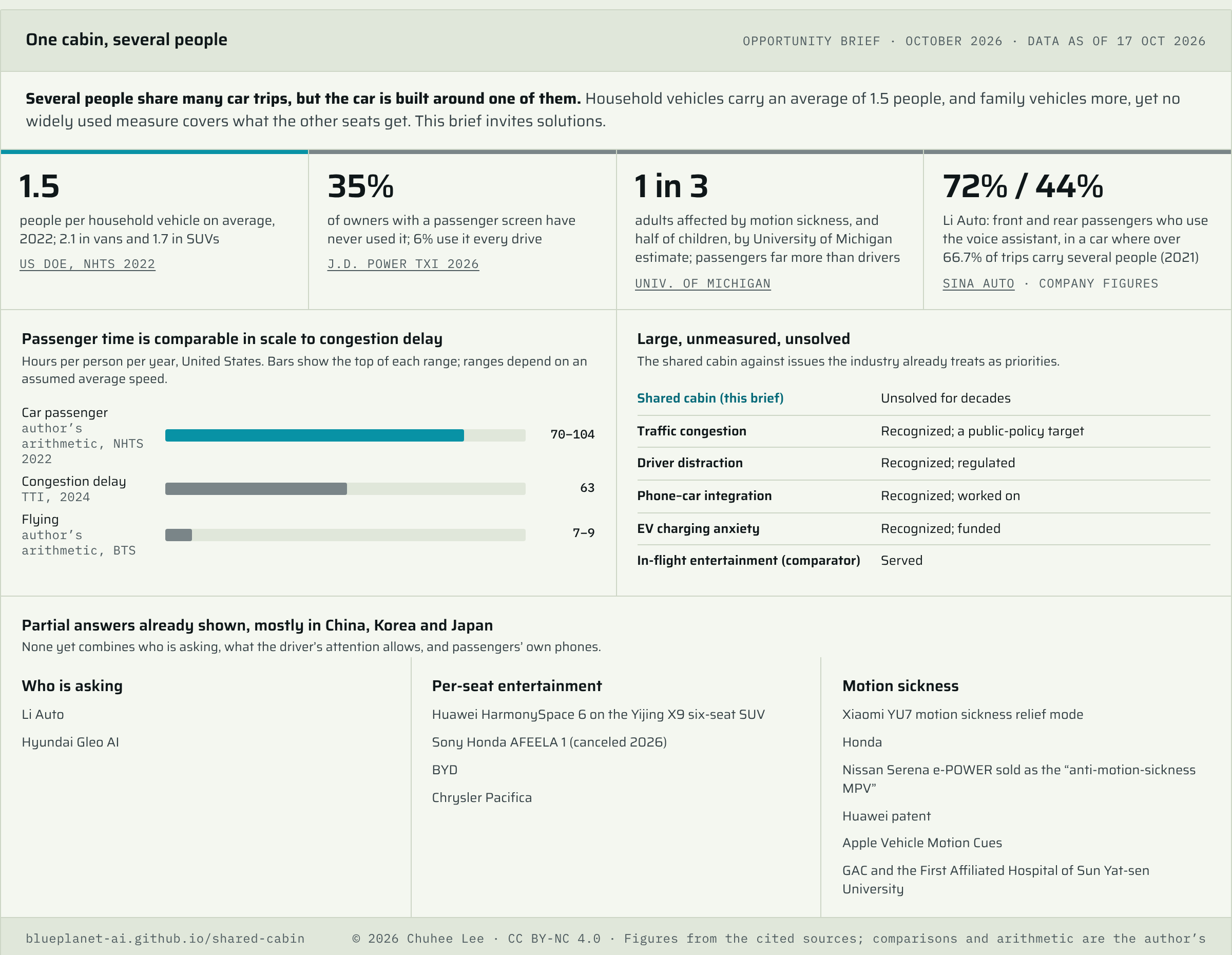
The short versionThe car is designed around one person, the driver. Everyone else in it is a guest using their own phone. Measured in hours, the time Americans spend riding as passengers is comparable in scale to the time they lose to congestion (the two measures differ) and about ten times the time they spend flying. Yet unlike congestion, distraction or charging, this brief found no widely used measure of its cost, and decades of attempts have not produced a good answer. This brief does not propose a product. It sets out the evidence and invites solutions.
Shared trips are common, and passenger time is large.
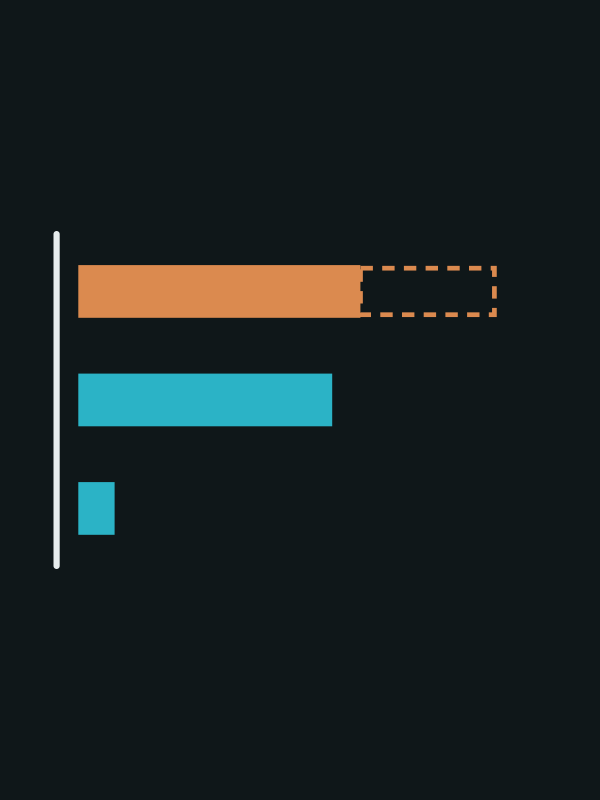
Household vehicles carried an average of 1.5 people in 2022; vans carried 2.1 and SUVs 1.7.[2] Together they carried about 0.79 trillion passenger-miles that year, roughly 70 to 104 hours a year per person (author’s arithmetic). That is comparable in scale to the 63 hours Americans lost to congestion in 2024, although riding time and delay are different measures.[1][5]
Passenger screens, as built, mostly go unused.
35% of owners with a passenger screen have never used it, only 6% use it on every drive, and passenger screens draw 21.3 problems per 100 vehicles.[8]
Passengers, especially children, are the ones who feel unwell.
University of Michigan engineers estimate that about a third of adults and half of children are affected by motion sickness, and that passengers suffer it far more than drivers. In a UK survey, 34% of drivers with children said their children get car sick.[12][13]
The pieces exist, mostly in China; no whole answer turned up in the sources reviewed.
Seat-zoned voice, rear-seat entertainment and motion-sickness drive modes are already in production. No concept found combines knowing who is asking, what the driver’s attention allows, and how passengers’ own phones fit in (author’s analysis).[24][30]
Large, unmeasured, unsolved.
Congestion, driver distraction, phone integration and EV charging each have a cost figure and an owner. The shared cabin has neither. That gap, more than the technology, is why the problem persists (author’s interpretation).
Passenger time is comparable in scale to congestion delay
Hours per person per year · United States
Bars to scale (125 hours = full width). Solid bars show the low end; dashed outlines show the range, which depends on an assumed average speed (see Method). Denominators differ: the passenger and flying figures are per resident, while TTI reports congestion delay per traveler. Sources: NHTS 2022 [1], TTI [5], BTS via FRED [11].
A cabin built for one
The car knows one person, the driver; everyone else is a guest using their own phone, and anything offered to passengers must not cost the driver attention.
Shared trips are common. Household vehicles carried an average of 1.5 people in 2022; vans carried 2.1 and SUVs 1.7.[2] Weighted by distance, household vehicles carried about 1.43 people per vehicle-mile (author’s arithmetic from NHTS: 2.64 trillion person-miles over 1.85 trillion vehicle-miles).[1] FHWA’s own mileage-weighted occupancy factor is 1.52, which would imply about 0.96 trillion passenger-miles; this brief uses the lower figure.[42]
Passengers cannot always use the time. University of Michigan engineers estimate that motion sickness affects about a third of adults and half of children, and that passengers suffer it far more than drivers.[12] This is an attributed estimate, not a measured population figure. In a UK survey of 2,021 drivers, 34% of those with children said their children have been car sick; 27% of those avoid car travel with them altogether, and 41% of drivers with children dread long journeys with them.[13]
Passenger screens, as built, mostly go unused. In J.D. Power’s 2026 Tech Experience Index (68,084 owners), 35% of owners with a passenger screen had never used it and 6% used it on every drive; the screens drew 21.3 problems per 100 vehicles.[8] This shows that passenger screens as built are not earning their place; it does not show whether passengers would use or pay for a better-integrated experience. One truck maker’s engineer reportedly found that front passengers prefer their own phone and more storage, while rear passengers are often children without phones.[36]
Every passenger request competes for the driver’s attention. 3,208 people died in distraction-affected crashes in the US in 2024.[6] That count covers every kind of distraction, not only passenger requests. Of owners who reported a distraction-related problem in J.D. Power’s 2026 quality study, 46% pointed to the infotainment or touchscreen.[9] Crash risk rises when teen drivers carry teen passengers.[7]
How big is it?
Measured against problems the industry already treats as priorities, the shared cabin is largest on exposure, moderate on pain, and the only one with no widely used measure of its cost.
The comparison uses four yardsticks: how many people and hours are exposed, how many are affected, the cost that is already recognized, and whether the problem is being worked on. Figures are US unless stated.
| Issue | Exposure | How many are affected | Recognized cost | Status |
|---|---|---|---|---|
| Shared cabin (this brief) | About 0.79 trillion passenger-miles; 21 to 32 billion passenger-hours a year; 70 to 104 hours per person at an assumed 25 to 37 mph (author’s arithmetic)[1] | About a third of adults prone to motion sickness (University of Michigan estimate); 34% of UK parents report car-sick children; 35% of passenger screens never used[12][13][8] | Not measured. This brief found no study that puts a cost on unserved passenger time; congestion’s cost is measured at $269 billion a year | Unsolved for decades |
| Traffic congestion | 63 hours lost per person, 2024 | Urban travelers | $269 billion a year[5] | Recognized; a public-policy target |
| Driver distraction | Every trip | 3,208 deaths, 2024[6] | Regulated (EU distraction warning in all new cars from July 2026)[38] | Recognized; regulated |
| Phone–car integration | Most new cars | CarPlay and Android Auto connectivity is the largest single driver of change in infotainment problems, the only quality category that got worse in 2026[9] | Warranty and satisfaction cost (not public) | Recognized; worked on |
| EV charging anxiety | EV shoppers | 46% of EV rejecters cite charging availability; 44% cite charging time[10] | Lost EV sales; public charging programs | Recognized; funded |
| In-flight entertainment (comparator) | 1.14 trillion US airline passenger-miles; 2.3 to 2.9 billion passenger-hours; 7 to 9 hours per person (author’s arithmetic)[11] | All flyers | Airlines treat it as a product category | Served |
Why now
The hardware is already in the cabin, assistants can hold a conversation, and regulation now draws the line around the driver’s attention.
Seat awareness is becoming software. Analog Devices says its personal sound zone technology runs on speakers already fitted and could be sold as a paid feature after purchase.[18] Hyundai’s Gleo AI applies “turn on my heated seat” to the seat the request came from.[25] Garmin’s Unified Cabin routes audio and video to individual seats.[23]
Conversation is no longer the hard part. Every assistant in this site’s benchmark already understands natural language; the spread is in what it can operate.[40] The missing pieces are knowing who is asking and what the driver can afford at that moment.
Regulation sets the driver’s boundary. The EU’s distraction warning is required in all new cars from July 2026, which makes the rules for passenger features clearer.[38]
Other markets already treat the rear seat as a customer. In China, close to 900,000 new cars with rear entertainment screens were sold in 2024, up 122%, mostly premium SUVs and MPVs.[37]
A way to charge for it exists. A volume carmaker includes in-car gaming in a connected-services tier priced at $149 a year after the free period.[14]
Who is already there
Partial answers exist in the US and Europe and more in China, Korea and Japan; none covers the whole problem, and none publishes measured outcomes for passengers.
Listed to show what has been tried, not ranked. No company named here sponsored, reviewed or endorsed this brief.
Startups and suppliers
| Company | What it does for the shared cabin | Stage and evidence | What it shows |
|---|---|---|---|
| AirConsole (N-Dream, owned by KPIT) | Multiplayer games on the car’s screens, with passengers’ phones as controllers | In models from several European brands, a US volume carmaker (six 2027 models) and Tata[14][15] Company claim | Phone and cabin working together; exit to a supplier |
| Kardome | Identifies who is speaking and from which seat, on existing microphones | Seed led by Hyundai; $10m Series A, November 2024[17][16] | Seat awareness without cameras |
| Analog Devices | Personal sound zones as software on existing audio hardware | Announced August 2026[18] | Suppliers can ship it as a feature |
| Silentium | Active noise cancellation and a “personal sound bubble” per seat | Noise cancellation available on Cadence DSPs; sound-bubble production status not found[19] | Per-seat audio from a specialist |
| Audioscenic | Head-tracked 3D audio for individual listeners | About £1.5M raised (2020) with automotive as a target; no automotive customer found[20] | Early and small |
| Motion Sync | Seat cues that warn the body of upcoming turns and braking, against motion sickness | University spin-out; moved from an automaker pilot to a consumer retrofit product[21] | The aftermarket route |
| Holoride | Motion-synced VR for passengers | Insolvent in 2024 after a funding round failed; later restarted[22] | The cautionary case |
Concepts to learn from: China, Korea and Japan
| Part of the problem | Concept | Market and status | What it shows |
|---|---|---|---|
| Who is asking | Li Auto: four voice zones (driver, front passenger, rear left, rear right); a “sound lock” so the owner can ignore rear-seat commands; a passenger’s “me too” copies the driver’s setting[24] | China; shipped by over-the-air update, September 2021 Shipped | Seat-zoned voice has worked for five years |
| Who is asking | Hyundai Gleo AI: knows which seat a command comes from[25] | Korea, May 2026, then global; Pleos Connect, which includes Gleo AI, targeted for about 20 million vehicles by 2030 Target | Seat awareness reaching volume brands |
| Per-seat entertainment | Huawei HarmonySpace 6 on the Yijing X9 six-seat SUV: rear-seat projection screens, karaoke without microphones from any seat, reminders for a forgotten child or pet[26] | China, August 2026 Announced | The rear seat treated as a main customer |
| Per-seat entertainment | Sony Honda AFEELA 1 (canceled 2026): displays for each seat, spatial sound, rear entertainment on the top trim[27] | Planned for California; Sony Honda Mobility canceled the car and a second model in March 2026, before any delivery.[43] On the prototype, how apps behave while moving was still being studied[28] Canceled | Screens per seat; separation from the driver unresolved |
| Per-seat entertainment | BYD: karaoke in new premium models[29] | China, 2026 Reported | The cabin as a social space |
| Per-seat entertainment | Chrysler Pacifica: available seatback touchscreens for second-row passengers with Amazon Fire TV built in[46] | United States; 2026 model year, optional Shipped | Rear screens in a family vehicle; separation from the driver and from passengers’ own phones is not described |
| Motion sickness | Xiaomi YU7 motion sickness relief mode: tunes power delivery, regenerative braking and suspension; company tests show nausea frequency down 51% and onset 16% later[30] | China, July 2025 Company claim | Software on the drivetrain, no new hardware |
| Motion sickness | Honda: acceleration mapping that smooths low-speed EV torque[31] | Japan; in the e:Ny1, 2023 Reported | The same idea from a Japanese carmaker |
| Motion sickness | Nissan Serena e-POWER sold as the “anti-motion-sickness MPV”: motor-only drive, suspension, large windows, supportive seats[32] | Japanese model sold in Malaysia, April 2026; no test data published Company claim | Motion sickness as a family-car selling point |
| Motion sickness | Huawei patent: on-screen images of the car’s motion against the road for rear passengers[33] | China; published September 2023 Patent | The phone’s motion-cue idea on cabin screens |
| Motion sickness | Apple Vehicle Motion Cues: animated dots on the edges of an iPhone or iPad screen that follow the car’s motion, switched on automatically when the phone senses it is in a car[45] | United States and worldwide; iOS 18, fall 2024 Shipped | A phone-side answer already ships; the cabin does not use it |
| Motion sickness | GAC and the First Affiliated Hospital of Sun Yat-sen University: joint research and standards[34] | China; agreement signed July 2026 Announced | Moving toward clinical evidence |
| Contrast | LG AI Cabin Platform: cabin cameras and context-aware voice aimed at the driver[35] | Korea; CES 2026 private demonstration Announced | New “AI cabin” platforms still center on the driver |
Li Auto’s own data, from 2021, supports the problem: it reported that more than 66.7% of trips carried several people, and that front passengers used the voice assistant more than 72% of the time and rear passengers more than 44%.[44] Passengers are not a side case in a car built for families, so the assistant has to know who is speaking. (The English trade report of the same release gave 65% passenger-seat occupancy and attributed the 72% to the driver’s seat; the Chinese original reads as above.)[24] Most entries in this table are company claims or trade press. Labels: Shipped is on sale; Reported is a trade-press report of a product; Company claim is a result or claim by the maker; Announced is planned or demonstrated, not on sale; Patent is a filing, not a product.
Why not just the phone?
The phone keeps each passenger’s content and identity; the car adds what no single phone can do, so the likely answer orchestrates both.
| Capability | Phone | Car | Edge |
|---|---|---|---|
| Each passenger’s own content, accounts and payment | Strong | Weak unless linked to the passenger’s account | Phone |
| Shared screens and a shared experience for several people | One person per device | Built in (AirConsole uses phones as controllers on the car’s screens)[15] | Car |
| Separate sound per seat without headphones | Not possible | Personal sound zones on existing speakers[18] | Car |
| Knowing which seat is speaking | Not possible | Seat-zoned voice (Li Auto, Hyundai, Kardome)[24][25] | Car |
| Knowing the car’s next maneuver (for motion sickness) | Infers from its own sensors (Apple’s motion cues) | Native vehicle state; can also change how the car drives (Xiaomi, Honda)[30][31] | Car |
| Knowing what the driver’s attention allows right now | Not possible | Driver monitoring and driving state are in the car | Car |
Author’s analysis based on the evidence cited. Products that fight the phone repeat the passenger-screen result; a promising design hypothesis uses passengers’ phones and the cabin together.
Business model and entry wedges
Three routes to revenue exist today; four starting points look open to a solver.
Ways to get paid
Through the carmaker
- License or per-car software fee, usually through a tier-one supplier.
- Long design cycles; suppliers can bundle the same feature.
- An idea, with no example found: content or game platforms paying carmakers or software providers for built-in delivery to several passengers.
As a paid tier or upgrade
- Connected-services tier or a feature unlocked after purchase.
- The only public price found is a volume carmaker’s $149 a year tier[14]; take rates are not public.
Why no whole answer yet: the author’s hypotheses
If most of the pieces exist, why has no one joined them? These are possible reasons to investigate, not findings of this brief.
- Split ownership. Voice, audio, screens, seats and climate usually come from different suppliers and teams.
- Closed vehicle data. Access to seats, microphones and vehicle state differs by carmaker, and a phone cannot reach most of it.
- Long design cycles. A feature agreed now reaches cars years later.
- Hard to know who is asking. Seat awareness and permission rules are needed, and this brief did not find them settled.
- Driver safety limits. Anything shown or said to passengers must not reach the driver’s view or attention.
- Unproven payment. Owners often do not use passenger screens, and no source reviewed shows passengers paying for a better experience.
- No shared standard found. This brief did not find a common way to link passengers’ phones with cabin systems; it did not search for one in depth.
Entry wedges, as invitations
| Wedge | What it would do | Evidence that it matters |
|---|---|---|
| Family long-trip mode | Motion-aware, seat-aware entertainment for children that never reaches the driver’s view, possibly paired with gentler drive modes | 34% of UK parents report car-sick children; 41% dread long trips with them[13] |
| “Who’s asking” layer | Seat identification plus driver-attention rules for any assistant | Li Auto reported front-passenger voice use above 72% and rear above 44%, with over 66.7% of trips carrying several people[44] |
| Sound per seat | Separate audio per seat as a software upgrade on existing speakers | Supplier says it can be sold after purchase[18] |
| Motion-sickness mitigation | Uses the car’s knowledge of its next maneuver, in the drivetrain, seat or screens | Xiaomi reports 51% fewer nausea episodes in its own tests[30] |
Illustrations to spark your own ideas
These are examples of the kind of answer a solver might explore. They are the author’s illustrations, not recommendations and not validated: each builds on the evidence above and would need testing with real passengers, drivers and carmakers.
A coordination layer between phones and the cabin
- Each passenger’s phone acts as the controller, while the car supplies seat position, audio and vehicle state, a rule for what the driver can safely be shown, and a rule for who may ask for what.
- Pieces exist: phones as game controllers[14] and seat-zoned voice[44]. Open question: who owns the layer, the carmaker, a supplier or a new company?
Comfort for passengers in electric cars
- Motion sickness may matter more in electric cars, where regenerative braking and quick acceleration change how a ride feels. The trade-press piece cited here describes the link, and Xiaomi and Honda tune their drivetrains for it.[30][31]
- A cabin-level answer could combine drivetrain tuning with seat cues and screens. Open question: how much relief, for whom, and who pays?
Passenger features that run in the car, not the cloud
- Seat-aware requests, per-seat audio and comfort settings handled on the car’s own computer could work without a connection and keep voices and audio off the cloud.
- Components already run on existing hardware: seat-aware voice on existing microphones[16] and sound zones on existing speakers[18]. Open question: what can the car’s computer carry safely?
Questions any solver would need to answer
- Which passenger problem comes first? Motion sickness, boredom, fights over the screen or audio, or requests that distract the driver.
- Who feels it most? Families on long trips, the daily school run, or groups of adults.
- What do passengers do today? Phones, headphones, a tablet, or nothing.
- Who is the user, who benefits, who buys and who distributes? The passenger has the problem, but the owner, the carmaker or a supplier may control the purchase.
- Who may ask the car for what? A rear passenger changing the temperature is different from one changing the route.
- Can it work across cars and stay safe for the driver? Access to seats, audio, microphones and vehicle data differs by carmaker.
- Who captures the value? A carmaker’s own team, a supplier or a new company.
What would show the opportunity is smaller than it looks
A good brief also says what would weaken its case. These tests are the author’s suggestion for any solver, not results.
| Test | Evidence that would support it | Evidence that would weaken it |
|---|---|---|
| Passengers have a real unmet need | Interviews and observed trips show recurring, consequential problems | Most passengers are content with phones, headphones and existing cabin features |
| Coordination beats separate apps | Users repeatedly prefer a coordinated experience on real trips | Users prefer separate devices and do not value coordination |
| The car adds something a phone cannot | Seat identity, audio and vehicle state enable useful features phones cannot match | Phone-only solutions give comparable results at lower cost |
| A buyer exists | A named buyer pays for, or funds a pilot of, the solution | Interest is positive but no one accepts the cost or the integration work |
| It scales across cars | One integration approach works across several platforms | Each carmaker needs bespoke engineering and its own negotiation |
Risks, potential and complexity
Exposure is large and solid; demand, payment and the supplier squeeze are the open questions.
Demand is unproven. Owners don’t use passenger screens, and stated interest often doesn’t become payment.[8]
Suppliers move fast. Audio, voice and cabin suppliers can add seat awareness as a feature, which squeezes startups; the best-known passenger startup so far, AirConsole, now belongs to a supplier.[15]
Privacy. Reusing driver-monitoring cameras for passenger features faces the EU’s closed-loop rules; voice and audio approaches avoid cameras.[38] How the rules apply to passenger features has not been checked against the official texts for this brief.
Measurement. No study measures the cost of unserved passenger time directly. The exposure figure is solid; the pain is shown through proxies.
Method, limits and flags
Read before citingQuestion. Is the shared car cabin, where a driver and passengers ride together, a problem large enough to be worth solving, and where could a solution start?
Scope. Problem sizing is for the United States. Concepts are drawn from the US, Europe, China, Korea and Japan. Placed under Opportunities / Mobility on this site. This is an invitation to solve, not a recommendation to any company.
Evidence base. Builds on this site’s Mobility Product Outlook, Physical AI Outlook 2026–2031 and In-Car AI Assistant Benchmark, with Agentic AI and the Consumer as supporting evidence.[39][38][40][41]
Sources. Official statistics first (FHWA, BTS, NHTSA, USDOT), then benchmark studies (J.D. Power, TTI), then company releases and trade press. Each reference carries its type and date.
Arithmetic (author’s). Household-vehicle person-miles = 23.69 daily miles per person × 305.561 million people × 365 = 2.64 trillion; minus 1.848 trillion household vehicle-miles = 0.794 trillion passenger-miles (NHTS 2022).[1] Passenger-hours = passenger-miles ÷ an assumed 25 to 37 mph (the upper speed is what DOE’s reported driving time and distance imply) = 21.5 to 31.8 billion hours, or 70 to 104 hours per person. Illustrative value of time (not a loss, a market size or willingness to pay) = hours × $21.80 per person-hour (USDOT all-purpose rate, 2024 dollars) = $0.47 to $0.69 trillion; at USDOT’s $20.10 personal-travel rate, $0.43 to $0.64 trillion.[4] Flying = 1.14 trillion revenue passenger-miles (12 months to June 2026) ÷ an assumed 400 to 500 mph = 2.3 to 2.9 billion hours, or 7.5 to 9.3 hours per person.[11]
What this brief is not. The problem statement, the comparison reading, the phone table, the framing, the reasons no whole answer exists yet, the entry wedges, the illustrations, the tests and the potential-versus-complexity view are the author’s analysis, not sourced figures.
Flags and open questions
- The hours figure depends on an assumed speed. The speed range of 25 to 37 mph is the author’s assumption. DOE reports household vehicles driven 64.6 minutes a day and 39.7 vehicle-miles a day; if both describe the same unit, that implies about 37 mph, which sets the top of the speed range and the bottom of the hours range. The units behind those two figures were not confirmed, and a different speed would move the hours.[3]
- Denominators differ. TTI’s 63 hours is reported per traveler; the passenger and flying figures are per resident. National congestion delay in hours was not found in the 2025 release.
- Motion sickness prevalence. “A third of adults and half of children” is the University of Michigan’s own estimate in an engineering news release, with no sampling method given, not a peer-reviewed prevalence study. The UK child figures are from an insurer’s survey.
- Passengers as a distraction source. NHTSA’s 2024 summary gives no passenger figure; the IIHS evidence covers teen drivers with teen passengers only.
- Company claims not independently verified: Xiaomi’s 51% figure, Hyundai’s 2030 target, Nissan’s comfort claims. Li Auto’s usage figures date from 2021.
- Not covered: EU problem sizing; take rates for paid connected tiers; how EU closed-loop rules apply to passenger features; Chinese demand data.
- One-time brief. This brief will not be refreshed; figures are as of 17 October 2026.
Change log
- October 2026
- AddedFirst opportunity brief, data as of 17 October 2026.
Related reports on this site
Physical AI Outlook 2026–2031 (physical AI across sectors) · Mobility Product Outlook 2026–2031 (passenger screens and customer expectations) · In-Car AI Assistant Benchmark (seat awareness and vehicle control) · Agentic AI and the Consumer Outlook 2026–2031 (trust and control)
About this brief
Personal research by Chuhee Lee. Research, source verification and drafting were carried out with Claude (Anthropic); figures were then cross-checked with other AI assistants and against primary sources. Every factual claim is sourced to the references listed below. Topic selection, framing and conclusions are the author’s. These are personal research projects; the views are the author’s own and do not represent any employer or organization. No company named sponsors, reviews or endorses this brief, and product names and trademarks belong to their owners. Licensed under CC BY-NC 4.0.
References
- [1] FHWA — Summary of Travel Trends: 2022 National Household Travel Surveyprimary (federal statistics) · 2024
- [2] US DOE — FOTW #1333: average occupancy of household vehicles was 1.5 (2022 NHTS; DOE words it per trip, FHWA tables the same figures as mileage-weighted occupancy)primary (federal) · 11 Mar 2024
- [3] US DOE — FOTW #1356: household vehicles were parked 95% of a typical day in 2022primary (federal) · 19 Aug 2024
- [4] Caltrans — Cal-B/C and federal value comparison (USDOT value of travel time, $21.80 per person-hour in 2024 dollars; USDOT’s 2026 guidance lists this as the all-purpose rate and $20.10 for personal travel)secondary (state DOT, citing USDOT) · 2026
- [5] Texas A&M Transportation Institute — 2025 Urban Mobility Report releaseresearch institute · Oct 2025
- [6] NHTSA — Distracted driving in 2024primary (federal) · 2026
- [7] IIHS — Passenger effects on teenage driving and opportunities for reducing the risksresearch institute · 2007
- [8] J.D. Power — 2026 U.S. Tech Experience Index (68,084 owners)benchmark study · Aug 2026
- [9] J.D. Power — 2026 U.S. Initial Quality Study (78,514 owners)benchmark study · 25 Jun 2026
- [10] J.D. Power — 2026 U.S. Electric Vehicle Consideration Study (8,154 shoppers)benchmark study · 14 May 2026
- [11] BTS via FRED — Revenue passenger miles, US air carriers, domestic and internationalprimary (federal statistics) · read Oct 2026
- [12] University of Michigan — Motion sickness technology could alleviate symptoms for passengersuniversity · May 2025
- [13] Churchill Motor Insurance (Censuswide, 2,021 UK drivers) — High rates of car sickness in kidsvendor survey · Oct 2024
- [14] AutoGuide — AirConsole in-vehicle gaming comes to select 2027 modelstrade press · Sep 2026
- [15] Automotive World — N-Dream, KPIT and Tata bring AirConsole to Indian EVstrade press (company claims) · 2026
- [16] Kardome — 2024: a year of growth and innovationprimary (company) · Dec 2024
- [17] Globes — Hyundai invests in Israeli voice tech company Kardomepress · undated, read Oct 2026
- [18] TheElec — ADI unveils personal sound zone technology for in-car audiotrade press (company figures) · Aug 2026
- [19] audioXpress — Silentium in-car active noise cancellation on Cadence Tensilica HiFi DSPstrade press · 2025
- [20] University of Southampton — Spinout leads sound revolution with £1.5m investmentuniversity · Nov 2020
- [21] University of Michigan Center for Entrepreneurship — Motion Syncuniversity · Feb 2026
- [22] Mixed — In-car VR startup Holoride files for insolvencytrade press · 2024
- [23] Garmin — Unified Cabin 2026primary (company) · 6 Jan 2026
- [24] Gasgoo — Li Auto releases OTA 2.2 with multi-section voice controltrade press (company figures) · 16 Sep 2021
- [25] Driven — Hyundai’s new Pleos Connect infotainment systempress · 2026
- [26] News18a — Yijing X9 debuts HarmonySpace 6trade press · 10 Aug 2026
- [27] Sony Honda Mobility — Introduces AFEELA 1 at CES 2025 (company release as republished by Ubergizmo)company release via trade press · Jan 2025
- [28] Electrek — Hands-on with Sony’s AFEELA prototypetrade press · 28 Mar 2024
- [29] SCMP — Karaoke car: China’s new wave of gadget-laden electric vehiclespress · 15 Aug 2026
- [30] elektroauto-news — Why EVs can cause motion sickness, and what makers do about it (Xiaomi YU7)trade press (company figures) · 24 Jul 2025
- [31] CAR — Honda wants to quell motion sickness by making EVs more ICE-liketrade press · 1 Aug 2023
- [32] Nissan Malaysia (ETCM) — The anti-motion sickness MPV: all-new Serena e-POWERprimary (distributor) · 2 Apr 2026
- [33] Gasgoo — Huawei patents in-vehicle anti-nausea system based on visual compensation imagestrade press · Sep 2023
- [34] Gasgoo — GAC Group and the First Affiliated Hospital of Sun Yat-sen University sign agreementtrade press · Jul 2026
- [35] ChannelLife — LG unveils AI Cabin Platformpress · 11 Dec 2025
- [36] The Autopian — Barely anyone uses the passenger screenpress (anecdote) · 2026
- [37] ResearchInChina via Business Wire — China automotive display report (rear entertainment screens, 2024)vendor research · Jun 2025
- [38] Chuhee Lee — Physical AI Outlook 2026–2031 (this site)own report · Nov 2026
- [39] Chuhee Lee — Mobility Product Outlook 2026–2031 (this site)own report · Nov 2026
- [40] Chuhee Lee — In-Car AI Assistant Benchmark (this site)own report · Nov 2026
- [41] Chuhee Lee — Agentic AI and the Consumer Outlook 2026–2031 (this site)own report · Nov 2026
- [42] FHWA — 2022 NHTS vehicle occupancy factors (mileage-weighted)primary (federal statistics) · Dec 2023
- [43] The EV Report — Sony Honda Mobility cancels AFEELA electric vehiclestrade press · 25 Mar 2026
- [44] Sina Auto — Li ONE OTA 2.2 multi-seat voice control (in Chinese)trade press (company figures) · 10 Sep 2021
- [45] 9to5Mac — iOS 18 Vehicle Motion Cues for motion sicknesstrade press · 27 Sep 2024
- [46] Chrysler — 2026 Pacifica technology (rear-seat touchscreens, Fire TV built in)primary (company page) · 2026