 Chuhee Lee

At a glance
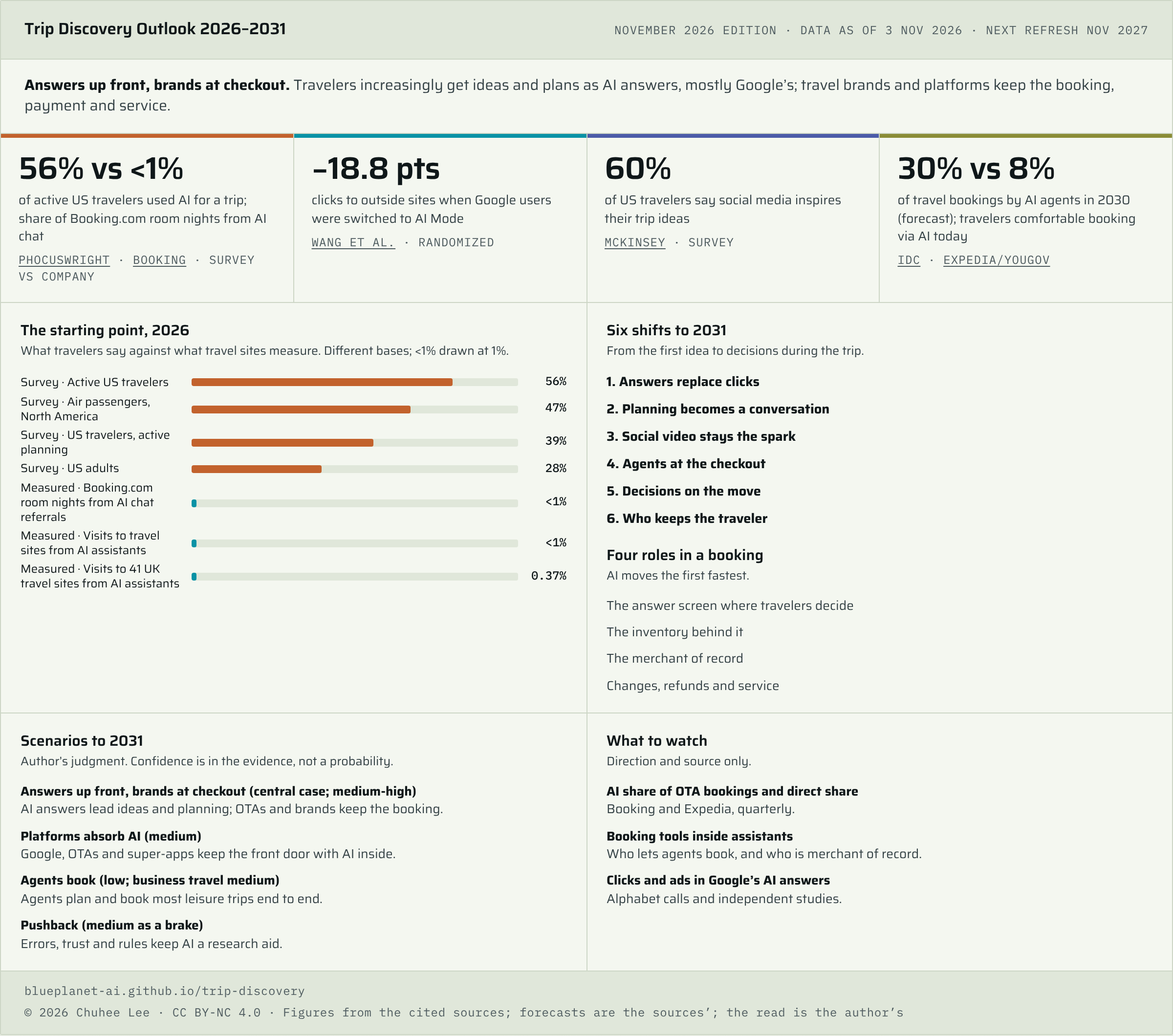
One-page summaryHeadline findingThrough 2031, travelers increasingly get trip ideas and plans as answers rather than clicks, mostly from Google, while travel brands and platforms keep the booking, the payment and the service.
Summary
The short versionExpert forecasts and today’s evidence point the same way for the next five years: travelers will increasingly get trip ideas, comparisons and plans as answers, from Google, chat assistants, travel apps and social video, rather than by clicking through pages of results. The checkout moves much more slowly. The author’s central case for 2031, “Answers up front, brands at checkout”, is that whoever owns the answer screen will not usually be the one who takes the payment, carries the booking and handles the cancellation. Trip discovery leaves the click; the booking stays with brands and travel platforms.
We start from a gap.
Surveys put AI use for trips at 28% to 56% of US travelers, depending on who is asked and how. Travel sites measure less than 1% of their visits or bookings arriving from AI assistants. Most of the gap is answers that never send a click, and AI inside Google counted as search.[1][2][3][9]
Answers replace clicks.
Search engines as travelers’ most-used research tool fell from 51% to 36% in about 18 months in Phocuswright’s tracking. In a randomized field experiment, Google’s AI Mode cut outbound clicks by 18.8 percentage points, yet Google reported its fastest query growth in five years.[10][4][11]
Planning becomes a conversation; social stays the spark.
AI trip planners mostly look for activities, ideas and food. 60% of US travelers say social media inspires their trips. The best models still produce a valid multi-constraint itinerary less than half the time in research benchmarks.[2][12][13]
The starting point: what travelers say against what sites measure
Percent · different bases, two kinds of measure · 2026
Survey bars and measured bars use the same axis but answer different questions: the first share people, the second share visits or bookings. The “less than 1%” bars are drawn at 1%.[1][19][10][2][3][9][20]
Where we start in 2026
Travelers say they use AI for trips far more than travel sites can measure; the gap is mostly how answers work, not a measurement error.
What travelers say. 56% of active US travelers used AI for planning, booking or in-destination help on at least one trip in the past 12 months, up from 33% in the first half of 2025.[1] Narrower questions give lower numbers: 39% of US travelers actively use AI to plan trips (Phocuswright), 49% of air passengers worldwide and 47% in North America have used AI for travel planning (IATA, over 10,000 responses), and 28% of US adults used AI to plan a trip in the past six months, up from 19% in August 2024 (Longwoods, 1,000 adults matched to the Census).[10][19][2]
What travel sites measure. Booking Holdings says referrals from AI chat assistants still bring significantly less than 1% of Booking.com’s room nights, though they “accelerated over the last several weeks” of the third quarter, and in every travel category Bain tracked with Similarweb data, AI referrals stay under 1% of site traffic.[3][9] Across 41 UK travel sites, 0.37% of visits came from AI assistants, 88% of them from ChatGPT.[20]
Why the gap. Most AI travel answers send no click; Google’s AI answers are counted as search; and a traveler who asks ChatGPT and then opens the Booking.com app shows up as a direct visit. Survey wording widens the range: Phocuswright’s 56% counts planning, booking or help at the destination. Half of travelers who use AI in search engines still click through to the source.[1] The site’s earlier analysis of this gap is folded into this chapter.
Where the money sits. OTAs took about one fifth of US travel gross bookings in 2025, 100.3 billion dollars, and Booking.com and Expedia take about two-thirds of their consumer bookings direct, through their own apps and sites.[21][3][6]
Answers replace clicks
AI answers become the first stop for trip research; clicks to travel sites fall faster than bookings, and the answer is mostly Google’s.
What experts forecast. Phocuswright says AI is “on a path to replace traditional search as the primary front door” for travel. Its tracking shows general search engines falling as travelers’ most-used research resource, from 51% in mid-2024 to 36% in late 2025.[10] Generative AI platforms such as ChatGPT reached 33% use for trip research, five times their 2024 level.[22]
What AI answers do to clicks. In a preregistered field experiment with 1,100 US Google users, switching people to AI Mode only cut the share of searches with a click to an outside site by 18.8 percentage points, lowered trust in Google’s information and raised searching on rival engines by 11.2 points. Removing AI features raised clicks by 8.8 points.[4] The study is a preprint and not about travel alone.
But Google grows. In the third quarter of 2026 Google’s search advertising revenue rose 12% to 63.3 billion dollars, query growth was the highest in five years, and AI Mode queries were three times longer than traditional searches, one in five using voice, images or documents. Google is now expanding ads in AI Mode internationally.[11] The growth costs something: search revenue growth slowed from 17% in the second quarter, and Google’s chief business officer said “the strong growth in AI Mode queries had an impact because of the lower monetization we were seeing in AI Mode”, alongside currency, the EU’s end of a customs exemption and a post-World Cup comedown.[23][11] In the experiment above, participants chose AI Mode for only 0.6% of their searches; AI Overviews appeared on 36%.[4]
Who gets cited. In 1,357 citations Gemini gave for Tokyo hotel questions, price-led questions (“cheap hotel in Shinjuku”) mostly cited OTAs, while experience-led questions drew a majority of citations from hotels, guides and other non-OTA sources.[24] Expedia says answer-engine optimization and social are two of its fastest-growing marketing channels.[6] Skift’s 2026 megatrends tell travel brands to optimize for AI-driven discovery, “GEO over SEO”, and Bank of America calls agentic AI the most significant theme for online travel in 2026, a challenge to “traditional search-and-click models”.[25][26]
What AI Mode does to clicks
Change in percentage points against today’s Google · 1,100 US users · randomized, March 2026
The −18.8 bar shows the size of a drop. Preprint by researchers at the University of Pennsylvania and Northeastern University.[4]
Planning becomes a conversation
Itineraries start as AI drafts that travelers check; travel companies’ own planners gain on standalone startups, and accuracy decides how far people trust them.
What people do with it. US adults who used AI to plan a trip mostly looked for attractions and activities (54%), inspiration for places to visit (44%) and dining (42%).[2] In Japan, 61% of people planning a summer trip in 2026 said they would use generative AI to look up local food, build itineraries or compare transport, and the survey’s sponsor said AI is replacing the guidebook.[28] In Cornell’s survey of 1,029 US travelers, AI ranks fourth among planning tools, behind search engines, review websites and official hotel sites; more than 60% name accuracy as the main barrier.[29]
Accuracy is the limit. In a 2024 benchmark of 1,225 realistic trip requests, GPT-4 produced a plan meeting every constraint 0.6% of the time.[30] A 2026 re-test of GPT-5.2, Claude Sonnet 4.5, Gemini 3 Pro and others found the best model succeeded 43% of the time on that benchmark, 15% or less on a harder one, and no model extracted every constraint exactly on a set of Chinese trip requests.[13] Public incidents, such as AI tools sending tourists in Peru to a canyon that does not exist, keep the risk visible.[31]
Travel companies build their own. Expedia bought the AI planner Layla in July 2026. Its chief executive said its natural-language tools “are not driving conversion right now” but give over 60% more information about what travelers want.[32][6] Trip.com says orders assisted by its TripGenie assistant rose about 400% in a year, with nearly 60% of interactions now about booking.[18] Human advisors are adding AI rather than being replaced by it: Fora, a platform for independent advisors, raised money at a 1 billion dollar valuation in July 2026.[33]
Where AI leads, travel changes. Among 2,669 foreign visitors to Seoul, the 23 who named generative AI as a leading information source spread their spending across more categories and visited the city’s iconic heritage sites less.[34] The group is small, but it is the first sign that AI planning changes where tourists go, not just how they book.
What US AI trip planners use it for
Share of adults who used AI to plan a trip · Longwoods, 1,000 US adults, July 2026
Base: the 28% who used AI to plan a trip in the past six months; subgroup size not published.[2]
Agents at the checkout
Forecasters expect AI agents to book a large share of travel by 2030; today’s products keep the travel company as seller, and business travel moves first.
What experts forecast. IDC predicts that by 2030, 30% of travel bookings will be executed by AI agents; its public summary gives no method or definition.[7] For all US e-commerce, Morgan Stanley expects agentic shoppers to reach about 10% of online retail by 2030 (up to 20%), Bain expects 15–25% of purchases to be initiated, influenced or completed by agents, and McKinsey expects agents to “de-verticalize” shopping, pulling people away from single-category apps such as Expedia toward general assistants.[41][42][43] The forecasts differ mostly in what they count.
What travelers say. In Accenture’s survey of 5,003 leisure travelers in 12 countries (June 2026), 40% would fully hand comparing travel options to an AI agent but only 10% would hand over payment.[44] 44% of US travelers say they would book directly inside an AI platform and 40% would let an AI assistant handle flight and hotel bookings (Phocuswright).[22] Asked about comfort rather than intention, the numbers fall: 8% are comfortable booking through an AI platform and 68% prefer a trusted travel brand (Expedia and YouGov, US, UK and India).[8]
What products do. Google started hotel booking in AI Mode in the US in August 2026 with ten partners including Booking.com, Expedia, Marriott and Hilton; the hotel or booking platform remains merchant of record and handles customer service.[14] OpenAI’s checkout protocol is designed the same way.[15] Of more than 60 travel tools for Claude and ChatGPT checked in October 2026, five could finish a booking inside the chat, all for business travel, plus one for personal trips; Expedia, Booking.com, Kiwi.com and trivago only search and send the traveler to their own sites.[45]
Where agents already book. In China, Alibaba’s Fliggy moved its assistant from pilot to live bookings inside Alibaba’s Qwen AI app in March 2026, for flights, trains and attraction tickets; it reports AI orders up 800% during the Spring Festival campaign and conversion comparable to established OTAs.[46] There the assistant and the travel platform belong to the same company. In the US, small bookings come first: Booking Holdings says OpenTable’s native integration with OpenAI has become one of its fastest-growing channels, “from a small base”.[3] Travel executives expect more: about three-quarters of the 600 Accenture surveyed believe AI will be executing bookings, payments and disruption handling for customers within three years, and slightly more of them name AI-native platforms (21%) than airlines and hotels (19%) as the likely owner of the traveler relationship.[44]
The record. Booking without leaving the search page was announced as inevitable for a decade, until Tripadvisor closed its Instant Booking in 2026, one industry tracker notes.[47] OpenAI reportedly stepped back from in-chat checkout in March 2026.[48]
How far agents go: 2030 forecasts against 2026
Percent · different bases: travel bookings, US e-commerce, travelers, touchpoints, room nights
Ranges are drawn at their midpoint (Bain) or likely case (Morgan Stanley). The forecasts are not like-for-like: Bain counts purchases agents only influenced; IDC does not define “executed”.[7][42][41][8][37][3]
Decisions on the move
The fastest growth is during the trip: travelers ask where to eat, how to get there and what a sign says, first on the phone, then by voice and glasses.
In-trip use is already common. Among Korean Millennial and Gen Z travelers, help during the trip is the most common use of AI (32%), ahead of transport routes and price comparison.[49] US AI trip planners look for activities and dining more than for flights or hotels.[2] Phocuswright’s headline AI figure counts help at the destination.[1]
New interfaces are built for it. Google’s first Android XR audio glasses, made with Samsung, Gentle Monster and Warby Parker, arrive this fall with turn-by-turn directions based on where you face, reviews of the restaurant you are walking past, live translation and ride ordering.[50] In Korea, Naver’s AI Briefing reaches more than 30 million people a month, and its AI Tab, with 10 million users, moves from search to purchases and reservations.[17] The site’s In-Car AI benchmark tracks the same shift in cars.[51]
Who keeps the traveler
Owning the answer screen and owning the customer are splitting apart; channel shares barely move in forecasts, and the US, Europe and East Asia diverge.
Four roles, not one. A booking involves four roles: the screen where the traveler decides, the inventory behind it, the merchant of record who takes the payment, and the company that handles changes and complaints. AI is moving the first role fastest. Today’s AI booking products leave the other three with hotels, airlines and OTAs.[14][15]
Channel forecasts barely move. Phocuswright projects the OTA share of US travel gross bookings rising from 20% in 2025 to 21% in 2028.[21] In the UK, the supplier-direct share of the online market moves only from 78% to 81% over its six-year forecast, and the OTA share drifts from 20% to 19% by 2029.[52] Booking.com says its direct share stayed in the mid-60s percent over the four quarters to September 2026, with its app in the high 50s, and that Connected Trip transactions, which combine several travel products, grew almost 20%; Expedia says two-thirds of its consumer-brand bookings come direct and its business-to-business bookings grew 21% in the second quarter.[3][6]
What incumbents and skeptics say. Trip.com’s chairman, James Liang: “we see AI as an evolution of the travel user interface rather than simply a new traffic channel,” and agents will become “an increasingly important discovery and inspiration channel.”[18] Altimeter Capital’s Thomas Reiner expects OTAs to decline slowly, “like the Yellow Pages — permanently damaged, never deceased.”[47] Airbnb kept out of ChatGPT’s apps.[53]
| Region | Setup in 2026 | What it implies for 2031 |
|---|---|---|
| United States | Google adds hotel booking, price tracking and points to AI Mode; ChatGPT carries ads and travel apps; OTAs and brands keep the merchant role.[14][54][55] | Google holds the answer screen; OTAs and brands compete to be the bookable option inside it. |
| Europe (EEA) | The Commission fined Google 460 million euros for self-preferencing in search in July 2026; Google removed live prices and date filters from its travel units in September and excluded the EEA from its AI Mode flight tracking. Google says hotels report direct-booking clicks down as much as 30% after its earlier changes.[16][56][14][57] | Rules slow Google’s answers in travel and keep large OTAs strong; AI assistants must also disclose they are AI.[58] |
| East Asia | Naver keeps AI search inside Korea’s main portal; Alibaba’s Fliggy books inside Alibaba’s own AI app; ByteDance’s Doubao cites Douyin, its sister video app, in most travel answers; Trip.com builds AI into its app and paid a 5.28 billion yuan antitrust charge, replacing its tiered hotel distribution programs.[17][46][59][18] | Domestic super-apps keep discovery and payment together; global assistants play a secondary role. |
Channel shares in forecasts: little movement
Percent · Phocuswright market estimates
Different markets and bases: US share of all travel gross bookings; UK share of the online market. The UK forecast period runs 2023–2029.[21][52]
What holds it back
Accuracy, trust, regulation, liability and closed platforms slow the shifts, especially at checkout; none stops AI-assisted discovery.
| Force | Evidence | Effect on the shifts | Kind |
|---|---|---|---|
| Accuracy | Best model 43% on a planning benchmark; more than 60% of US travelers name accuracy as their main barrier.[13][29] | AI drafts, people verify; slows booking by agents. | Observed |
| Trust | 8% comfortable booking through AI; forced AI Mode lowered trust in Google’s information.[8][4] | Favors trusted brands at checkout. | Survey |
| Competition rules | EU fine and EEA redesign; Trip.com’s antitrust charge in China.[16][18] | Limits bundling of answers and booking by dominant platforms. | Observed |
| Pricing and consumer law | FTC orders to Delta, United, JetBlue and six others on prices set from personal data, loyalty status and algorithms (28 October 2026); UK regulator: “if an AI agent you use does something illegal, you are responsible.”[60][61] | Makes travel companies cautious about letting agents set prices or book unchecked. | Observed |
| Liability and service | Google and OpenAI leave the merchant role, cancellations and support with the travel company.[14][15] | Keeps the customer relationship with brands and OTAs. | Company |
| Closed platforms | Airbnb outside ChatGPT apps; big OTAs expose search, not booking, to assistants.[53][45] | Assistants cannot book what platforms keep closed. | Company |
| The pleasure of planning | Travelers move through overlapping “orbits” of ideas; trust in people decides.[12] | Browsing stays part of the trip for many leisure travelers. | Survey |
Scenarios to 2031
The author’s central case splits by role: answers up front, brands at checkout. One alternative is close; agents booking most leisure trips is the least supported.
How good are such forecasts? Forecasts that a new interface would take over travel booking have mostly been early: Google’s standalone Trips app closed in 2019, booking inside metasearch faded, and Gartner’s 2024 forecast of a 25% drop in search volume by 2026 has not shown up in Google’s numbers.[35][47][27][11] Forecasts of new habits have done worse than forecasts of infrastructure.[62] This report therefore trusts forecasts of AI use for ideas more than forecasts of AI taking over the checkout.
| Scenario | What 2031 looks like | Evidence for | Evidence against | Confidence |
|---|---|---|---|---|
| Answers up front, brands at checkout central case | AI answers, mostly Google’s and the big assistants’, are the first stop for ideas and planning. OTAs and travel brands keep the booking, payment and service, reached through hand-offs; travel sites get fewer but better-qualified visits. | Search as most-used research tool down from 51% to 36%; AI Mode keeps the hotel as merchant of record; big OTAs expose search, not booking; channel shares stable in forecasts. | Google may take more of the transaction over time; AI referrals are still under 1%, so the hand-off is not yet proven at scale. | Medium-high |
| Platforms absorb AI | Google, Booking, Expedia, Trip.com and Naver keep the front door with AI built into their own apps; standalone assistants stay a niche starting point for travel. | Direct shares in the mid-60s percent; TripGenie orders up about 400%; Fliggy books inside Alibaba’s own AI app; Naver AI Tab at 10 million users; Google Trips folded into Search and Maps. | Generative AI platforms reached 33% use for trip research; general assistants have daily habits travel apps lack. | Medium |
| Agents book | Agents plan and book end to end for a large share of leisure trips; OTAs become supply behind them and the assistant owns the customer. | IDC: 30% of travel bookings by 2030; three-quarters of travel executives expect AI to execute bookings within three years; payment protocols for agents; business-travel agents book in chat. | Best model 43% on a planning benchmark; 8% comfortable booking via AI; 10% would hand an agent the payment; platforms refuse the merchant role. | Low (business travel: medium) |
| Pushback | Errors, ads in answers, pricing scandals and regulation slow adoption; AI stays a research aid and travelers keep comparing themselves. | Forced AI Mode lowered trust; EU, Chinese and US regulators active; accuracy the top barrier. | Use is already broad and rising; ideas and in-trip help do not need full accuracy or booking. | Medium as a brake; low as a reversal |
Confidence describes how well the evidence supports each story, not a probability. Gemini and ChatGPT, asked to test these scenarios, both rated the central case and “Platforms absorb AI” as best supported and agents booking most leisure trips as least supported.
What would change the picture
AI’s share of OTA bookings and direct share
Booking Holdings and Expedia earnings calls. AI referrals rising to several percent of room nights while direct shares hold supports the central case; direct shares falling as agent bookings rise supports Agents book. In the third quarter, Booking said AI referrals were still significantly below 1% of room nights but accelerating; a first stated figure of 1% or more would be the first crossing.[3][6]
Planning benchmarks
Valid-plan rates on TravelPlanner and its successors. Rates well above half would make delegation credible.[13]
Method, limits and flags
Read before citingQuestion. How will AI assistants and agents, social video and new devices change how people discover, plan and book trips, and decide during them, by 2031, and who will stand between the traveler and the seller?
Scope. Leisure travel first, business travel where it shows what may reach consumers. Inspiration, planning, the booking hand-off and decisions during the trip. US first; Europe and East Asia as distinct setups.
Sources. Research papers, analysts’ and research firms’ forecasts, company disclosures, regulators, and major news and trade publications. Each reference carries its type and date. Observed, survey, company and forecast figures are kept apart and labeled.
How the research was done. Claude researched and verified the 2026 baseline and the forecasts; Gemini (research papers, government, Google material) and ChatGPT (analysts, companies, major publications) answered the same written brief; Claude opened their sources and merged the findings. Framing, the six shifts, the scenarios and conclusions are the author’s.
What this report is not. The “author’s forecast” boxes and the four scenarios are judgments based on the evidence cited. Confidence labels describe how well the evidence supports a statement, not a probability. Signposts give a direction and a source, not a numeric threshold.
Flags and open questions
- Third-quarter results in part. Alphabet (28 October) and Booking Holdings (3 November) third-quarter results are included, from Alphabet’s call transcript and Booking’s release and prepared remarks; Booking’s live question-and-answer session was not read, so company figures reported only from it (AI-assistant conversion rates, AI search visitors, OpenTable covers) are not used. Expedia (4 November), Airbnb and Tripadvisor (5 November) and Trip.com (date not announced) report later; their second-quarter statements are used.
- Forecasts, not measurements. This edition leans on what analysts, researchers and companies forecast to 2030–2031 and does not require each claim to be validated by an independent third party; each has a linked source. Many forecasters sell to the industries they forecast (IDC, Bain, McKinsey, Morgan Stanley, Phocuswright, Skift), and company figures (Google, Booking, Expedia, Trip.com, Naver) are claims. Each is labeled.
- Rescoped edition. An earlier draft of this report measured today’s gap between stated and measured AI use for trips; its verified figures now form chapter 1. Earlier sections on European distribution, Korean statistics and the AI trip-planning startup landscape were shortened or dropped.
- Research round with Gemini and ChatGPT, then Claude’s own pass. Both models answered the same written brief. Claude then searched independently for travel outlook reports, East Asian evidence and forward-looking research, which added Accenture’s traveler and executive survey, Fliggy’s live AI bookings, QuestMobile’s citation data, the Japanese survey, and the Skift, Amadeus and Bank of America outlooks. These agree with the two models’ findings; the main addition is that agent booking is already live in China where the assistant and the travel platform belong to one company. Claude opened the sources behind each new figure used here. Their main effects: the role split (answer screen versus merchant of record), business travel as the first market for booking agents, and treating the US, Europe and East Asia as different setups.
- Corrections from that round. Trip.com’s antitrust charge was 5.28 billion yuan, not 5.18 billion. The 460 million euro EU fine is the search part of an 890 million euro total. Alphabet’s third-quarter search revenue growth was 12%; the 17% figure belonged to the second quarter. Phocuswright’s 44% and 40% figures on booking through AI come from its July 2026 summary, not the March page.
- Not used because not verified or secondary only. Chinese figures on Golden Week AI planning, Alibaba’s Qwen orders and Doubao’s daily users seen only in a consultant’s blog; a figure of 36% of loyal travelers who would switch brands because of AI, not in the Accenture report; eMarketer’s in-chat checkout forecast and Gartner’s business-buying forecast (seen only through a vendor summary), Sabre’s MCP release notes (page did not load), a Sprout Social survey, a Skift article’s 2% figure (no named source), a hallucination study available only as an abstract, and a claim that 50% of searches would run through AI engines in 2026.
- Secondary and vendor sources. Booking Holdings’ second-quarter remarks come from an editor-reviewed transcript on Investing.com; Alphabet’s and Expedia’s from The Motley Fool. The check of AI booking tools was published by Engine, a business-travel booking company. The industry tracker quoting Altimeter Capital and Tripadvisor’s Instant Booking closure is a personal blog.
- Preprints and small samples. The Wang, Zhu and Zhang studies are preprints. The Seoul study’s leading-AI group is 23 people; the Skift and McKinsey diaries cover 26 travelers.
- Academic research looks backward. A review in Tourism Management of 170 empirical studies of generative AI in business and tourism (2022–2024) finds the field early and mostly quantitative; it offers research questions, not forecasts.[63] The forecasts in this report therefore come mainly from analysts, companies and research firms.
- Not found. A published method behind IDC’s 30% forecast; a forecast of AI-assistant booking revenue in travel; measured in-trip AI use; independent tests of current production trip planners; a scored archive of past travel-technology forecasts.
Change log
- November 2026 edition
- AddedFirst edition, data as of 3 November 2026. Rescoped before publication from a study of today’s trip discovery to a five-year forecast.
About this report
Personal research by Chuhee Lee. Research, source verification and drafting were carried out with several AI models, including Claude (Anthropic), Gemini (Google) and ChatGPT (OpenAI). Every factual claim is sourced to the references listed below; topic selection, framing and conclusions are the author’s. These are personal views, not those of any employer.
References
- [1] Phocuswright — The fastest shift in travel behavior just became the default (summary of “The AI Surge”; active US leisure travelers, 1H 2026; sample not stated on the page)research firm · Mar 2026
- [2] Longwoods International — American Travel Sentiment, Wave 109 (1,000 US adults from a consumer panel, quotas matched to the Census; fielded 7–9 Jul 2026)survey (research firm) · Jul 2026
- [3] Booking Holdings — Q3 2026 earnings prepared remarks, CEO and CFO (republished by MarketScreener); results in the Form 8-K releasecompany statements (republished) · 3 Nov 2026
- [4] Wang, Gleason, Bart, Wilson & Metaxa — AI in Search Reduces Publisher Referrals Without Improving User Experience: Experimental Evidence (arXiv:2608.18352; preregistered field experiment, 1,100 US Google users, March 2026)preprint, not peer reviewed · 18 Aug 2026
- [5] Investing.com — Earnings call transcript: Booking Holdings Q2 2026 (AI-assisted transcript, editor-reviewed)company statements (transcript) · 4 Aug 2026
- [6] Expedia Group — Q2 2026 earnings call transcript (The Motley Fool)company statements (transcript) · 5 Aug 2026
- [7] IDC (Dorothy Creamer) — Agentic AI will redefine travel and hospitality in 2026 (FutureScape predictions)analyst forecast · 23 Jan 2026
- [8] Expedia Group — “The AI Trust Gap”: travelers embrace AI for planning but rely on trusted brands to book (YouGov; 5,700+ adults, US, UK, India; fieldwork 10–25 Mar 2026; commissioned by Expedia Group)vendor-commissioned survey · 14 Apr 2026
- [9] Bain & Company — Travel operators can’t just watch as AI reroutes the customer journey (Similarweb traffic data, Jul 2025 vs Jul 2026; Bain Consumer Lab survey, sample not stated; Euromonitor spend data)consultancy · 30 Sep 2026
- [10] Phocuswright — Report preview: Travel Innovation and Technology Trends 2026 (US traveler and travel-executive surveys; samples not stated on the page)research firm · 2026 (page undated)
- [11] Alphabet — Q3 2026 earnings call transcript (Alphabet investor relations)primary (company statements) · 28 Oct 2026
- [12] McKinsey & Company — Winning hearts in an age of infinite travel choices (survey of 1,000+ US travelers plus 26 trip diaries)consultancy · 22 Sep 2026
- [13] Zhang, Ye, Hua, Cao, Shao, Li & Guo (Nanjing University) — Revisiting the Travel Planning Capabilities of Large Language Models (arXiv:2605.03308; GPT-5.2, Claude Sonnet 4.5, Gemini 3 Pro, DeepSeek V3.2, Qwen3 Max)preprint, not peer reviewed · 5 May 2026
- [14] Google (James Byers, Search) — How to book travel with AI Mode in Google Search: hotel booking, flight price tracking, points and milesprimary (company) · 27 Aug 2026
- [15] OpenAI — Buy it in ChatGPT: Instant Checkout and the Agentic Commerce Protocolprimary (company) · 29 Sep 2025
- [16] European Commission — Commission fines Google €890 million for breaches of the Digital Markets Act (€460 million for self-preferencing in Google Search; IP/26/1670)primary (regulator) · 23 Jul 2026
- [18] Trip.com Group — Q2 2026 earnings call transcriptprimary (company) · 16 Sep 2026
- [19] IATA — 2026 Global Passenger Survey: travelers embrace biometrics and AI, but entry requirements remain a barrier (over 10,000 responses, 200+ countries)industry association survey · 28 Oct 2026
- [20] ABTA partner insight by Adido — How much traffic do LLMs send to travel websites in 2026? (Google Analytics, 41 UK travel sites, 1 Jan–22 Apr 2026)agency analytics study · 2026 (page undated)
- [21] Phocuswright — 13% is the number that explains why OTAs need hotels to keep working (US travel market sizing and 2028 forecast)research firm forecast · Jul 2026
- [22] Phocuswright — AI sure hits its stride: 5 takeaways for travel leadersresearch firm · Jul 2026
- [23] Alphabet — Q2 2026 earnings call transcriptprimary (company) · 22 Jul 2026
- [24] Zhu & Chang — The End of Rented Discovery: How AI Search Redistributes Power Between Hotels and Intermediaries (arXiv:2603.20062; 1,357 Gemini citations for 156 Tokyo hotel queries; authors at Blossom AI)preprint, not peer reviewed · Mar 2026
- [25] Skift — How to use Skift Megatrends 2026: a playbook for travel operatorstrade press outlook · 12 Dec 2025
- [26] Hospitality.today — Five online travel themes for 2026 from Bank of Americasecondary (bank research) · 4 Feb 2026
- [27] Gartner — Gartner predicts search engine volume will drop 25% by 2026, due to AI chatbots and other virtual agentsforecast (track record) · 19 Feb 2024
- [28] Adnkronos — 61 pct in Japan to use AI for summer travel planning: survey (Meiji Yasuda Life; 1,120 people in their 20s–50s; 9–12 June 2026)news (company-sponsored survey) · 13 Jul 2026
- [29] Hospitality Net — Not one size fits all: how travelers are actually using AI to plan trips (summary of Jang & Anderson, Cornell Center for Hospitality Research; 1,029 US travelers)university-centre research (summary) · 29 May 2026
- [30] Xie et al. — TravelPlanner: A Benchmark for Real-World Planning with Language Agents (ICML 2024; arXiv:2402.01622)peer-reviewed conference paper · 2024
- [31] OECD.AI Incidents Monitor — AI-generated travel advice sends tourists to non-existent and dangerous destinations in Peruprimary (incident database) · 29 Sep 2025
- [32] Skift — Expedia acquired AI trip-planner Layla: exclusivetrade press · 31 Jul 2026
- [33] Fora — Fora announces Series D fundingprimary (company) · 16 Jul 2026
- [34] Kim & Lee — When Generative AI Is Reported as a Leading Travel Information Source, Sustainability 18(17):8955 (2024 Seoul Foreign Tourist Survey, n=2,669; 23 named GenAI a leading source)peer reviewed (MDPI) · 1 Sep 2026
- [35] Search Engine Land — Google discontinues Trips mobile appnews (track record) · 7 Aug 2019
- [36] TUI Group — Travel in the age of scrolling: TUI Musement research (Appinio for TUI Musement; Spain, Italy, UK; January 2026; sample not stated)vendor-commissioned survey · 25 Aug 2026
- [37] Skift Research — Mind the Gap: AI’s uneven role across the booking journey (diary study of 26 US travelers)research firm · updated 15 Oct 2026
- [38] GeekWire — New Expedia feature uses AI to help travelers plan and book trips based off shared Instagram Reels (Trip Matching)news (company feature) · 2025
- [39] TechCrunch — Former Meta engineers’ Airial travel tool helps travelers solve logistics planning with AIpress · 30 Jun 2025
- [40] Hospitality Net — Amadeus Travel Trends 2026: transformative travel for the coming year (with Globetrender)company trend report · 4 Dec 2025
- [41] Morgan Stanley — Here come the shopping bots (agentic commerce outlook to 2030)bank research forecast · 8 Dec 2025
- [42] Bain & Company — 2030 forecast: how agentic AI will reshape US retail (snap chart)consultancy forecast · 17 Dec 2025
- [43] McKinsey & Company — The agentic commerce opportunity: how AI agents are ushering in a new era for consumers and merchantsconsultancy forecast · 17 Oct 2025
- [44] Accenture Research — Win the AI agent, win the traveler (5,003 leisure travelers in 12 markets and 600 airline, hotel and OTA executives; fieldwork June 2026)consultancy survey · 2026
- [45] Engine — The 12 best MCP servers for booking business travel in 2026 (check of 60+ travel MCP servers in Claude and ChatGPT; Engine sells business-travel booking)vendor analysis · 7 Oct 2026 (updated 20 Oct 2026)
- [46] Travolution — Fliggy goes live with bookings via AI interface (Qwen App; company figures)trade press (company claim) · 27 Mar 2026
- [47] Alejandro Berdonces Corroto — AI and travel predictions 2026–2030: who says what (prediction tracker by a tour-operator AI product manager)expert view (blog) · 6 Oct 2026
- [48] Skift — ChatGPT bails on transactions: good news for Expedia and Bookingtrade press (OpenAI statement) · 5 Mar 2026
- [49] Hankyung (한국경제) — Korean MZ travelers plan with AI but check platform reviews before paying (Klook Travel Pulse, Korea cut; sample not stated)secondary (vendor survey) · 25 Jun 2026
- [50] Google (Shahram Izadi) — Intelligent eyewear with Gemini is coming this fall (Google I/O 2026)primary (company) · 19 May 2026
- [51] Chuhee Lee — In-Car AI Assistant Benchmark, October 2026 edition (this site)own report · 11 Oct 2026
- [52] PhocusWire — U.K. travel distribution: summary of Phocuswright’s U.K. Travel Market Essentials 2026 (forecast to 2029)trade press (research firm forecast) · 2026
- [53] Fortune (Bloomberg) — Brian Chesky says OpenAI tools not ready for Airbnb app tie-upsecondary (company statement) · 21 Oct 2025
- [54] OpenAI — Testing ads in ChatGPTprimary (company) · 9 Feb 2026 (updated 11 Aug 2026)
- [55] PhocusWire — Expedia and Booking.com launch apps in ChatGPT (with Perplexity partnerships)trade press · 7 Oct 2025
- [56] Skift — Google strips out EU travel search features to avoid more finestrade press · 8 Sep 2026
- [57] Google — New competition rules come with trade-offs (EEA hotel-search test)primary (company claim) · 2024
- [58] European Commission — Transparency obligations under Article 50 of the AI Act (FAQ)primary (regulator) · accessed 1 Nov 2026
- [59] 36Kr Europe — Where AI travel suggestions come from, citing QuestMobile’s report on AI platforms’ source preferences (Doubao, DeepSeek, Qianwen; April–May 2026)secondary (measured citation data) · 27 May 2026
- [60] US Federal Trade Commission — FTC launches personalized pricing and compensation inquiry (Section 6(b) orders to nine companies)primary (regulator) · 28 Oct 2026
- [61] UK Competition and Markets Authority — Using AI agents: complying with consumer lawprimary (regulator guidance) · 9 Mar 2026 (updated 30 Oct 2026)
- [62] Chuhee Lee — Media and Learning Outlook 2026–2031 (this site; forecast track record in the scenarios chapter)own report · 1 Nov 2026
- [63] Li, Xi, Hsu, Yu & Zheng — Generative artificial intelligence in tourism management: an integrative review and roadmap for future research, Tourism Management 110, 105179peer reviewed · Oct 2025

Social video stays the spark
Trips are still first imagined on social video; AI turns saved posts into plans, and trust in friends, creators and reviews decides which ideas survive.
Social leads inspiration. 60% of US travelers say social media inspires their trip ideas, but trust in friends, credible creators and reviews decides which ideas move forward, McKinsey found in a survey of more than 1,000 travelers and diaries from 26 travelers. It describes trip planning as a set of overlapping “orbits” rather than a funnel.[12] In Spain, Italy and the UK, 43% say they have booked a trip or activity after seeing a viral post or video, and 48% of Gen Z name TikTok as their main source of travel inspiration (TUI Musement, a seller of tours and activities).[36]
AI arrives later in the journey. In Skift Research’s diary study, AI accounted for 21% of touchpoints at the inspiration stage and 37% across inspiration and research combined, but 6% at booking. US travelers’ comfort with AI for ideas and research (net score 58) is about twice their comfort with AI for booking (27).[37]
From video to plan. Expedia’s Trip Matching turns an Instagram Reel sent to its account into a bookable itinerary, startups turn a TikTok link into stops on a map, and Google’s AI Mode accepts images as questions.[38][39][11] Amadeus calls the result “travel mixology”: travelers combine assistants, Reddit, YouTube and brands’ own tools rather than switching from one to another.[40] The leading content travelers save, and the reviews they read, become the material AI answers cite.
AI’s share of trip touchpoints, by stage
Percent of touchpoints · Skift Research diary study, 26 travelers · updated Oct 2026
The middle bar combines inspiration and research. A small diary sample; read the pattern, not the levels.[37]